

Just 2% of Britons say they never notice out-of-home advertising, and 19% have discussed an advertised brand with friends or family after seeing it, according to YouGov's out-of-home research.
Guerrilla advertising is built to exploit that: a message placed somewhere unexpected, then carried by the people who saw it.
Get it right and a poster pasted on a pavement, wall, or even a cat, can outrun a TV budget. Get it wrong and suddenly you're the story for all the wrong reasons.
Guerrilla advertising at a glance
- Guerrilla advertising is unconventional, usually physical advertising placed in unexpected spots, built to be photographed and talked about by whoever notices it.
- Guerrilla marketing is the wider low-budget strategy; guerrilla advertising is the execution that brings it to the street.
- The main types of guerrilla advertising are ambient, stunt, street, ambush, and undercover, viral and grassroots.
- The idea of guerrilla advertising traces back to Jay Conrad Levinson's 1984 book Guerrilla Marketing.
- Guerrilla advertising still needs a budget: permissions and production cost money before amplification even starts, and reach is high-variance.
- Displaying an advertisement without the right consent is a criminal offence in England.
What is guerrilla advertising?
Guerrilla advertising is an unconventional, usually low-cost ad placed in a street, a station or an everyday object, where a message is the last thing people expect. It's used to spark conversation and earned coverage, and it differs from standard out-of-home because the surprise itself carries the message.
The name borrows from guerrilla warfare, where small, mobile forces beat bigger ones by choosing the battlefield and the perfect moment to strike. In advertising, that means a brand or charity with a fraction of a rival's budget picking the right place or moment (a cultural flashpoint is the best moment going) and hitting it hard.
You'll often see it spelt "guerilla", with one r. Either way, the smaller you are, the louder the idea has to be, because someone richer has most definitely booked all the billboards on Piccadilly Circus already.
Guerrilla advertising vs guerrilla marketing: What's the difference?
Guerrilla marketing is the plan and guerrilla advertising is the ambush. The marketing side is a whole low-budget, unconventional approach to winning customers, covering pricing, partnerships and word of mouth. The advertising side is the specific ad, stunt or installation that carries that approach to the street.
The two get used as synonyms constantly, and blurring them is how briefs end up asking for "a guerrilla" before anyone has agreed on a strategy. Like sending in the troops before anyone has looked at a map.
The difference shows up in these specific ways:
- Scope: Guerrilla marketing covers every lever a business pulls; guerrilla advertising covers the message and where it lands.
- Output: Guerrilla marketing produces a plan, while guerrilla advertising produces a billboard, a stunt or a film.
- Timescale: Guerrilla marketing runs continuously; guerrilla advertising is usually a short, sharp burst timed to a moment.
- Measurement: Guerrilla marketing is judged on business growth; guerrilla advertising is judged on attention and on the coverage and conversation it earns.
Experiential work invites people into a brand's world; guerrilla drops the message into theirs, uninvited. For the invited version, see our pick of the best experiential marketing campaigns.
Disruption is a close cousin that works by breaking category conventions. Our guide to disruption in advertising and marketing explains where that line sits.
Why does guerrilla advertising work?
Surprise. That’s the core mechanism. Commuters filter out standard ad formats on autopilot, and guerrilla advertising works by breaking that pattern. A cat running for prime minister or a billboard mocking an oil boss's pay earns a second look, and the photo, the post and the conversation start there.
Conversation is the media plan. An execution seen in person by a few streets' worth of people only scales through the coverage and shares it earns. Read our guide to what earned media is and how you get it.
Guerrilla advertising is usually the spark; word of mouth carries the rest. Call it a pub chat you've paid to start. Our guide to buzz marketing breaks down how that talk builds.
The main types of guerrilla advertising
Most strong campaigns blend more than one type of guerrilla advertising. The types below are separated by where the idea lives: in the environment, in a staged moment, in public space, in someone else's event, or in the conversation itself.
Ambient advertising
Ambient work turns the environment into the medium: a bench, a staircase, a manhole cover or a high-street shop window reworked so the object itself carries the message. The best ambient work feels inevitable once you've seen it. The trap is treating the object as just another place to stick an ad. If the message would land just as well on a plain wall, you've made a sticker in a strange place.
The British Heart Foundation's In Living Memory benches are a recent example: in January 2026, 65 benches across the UK were painted BHF red, each named after a living survivor.
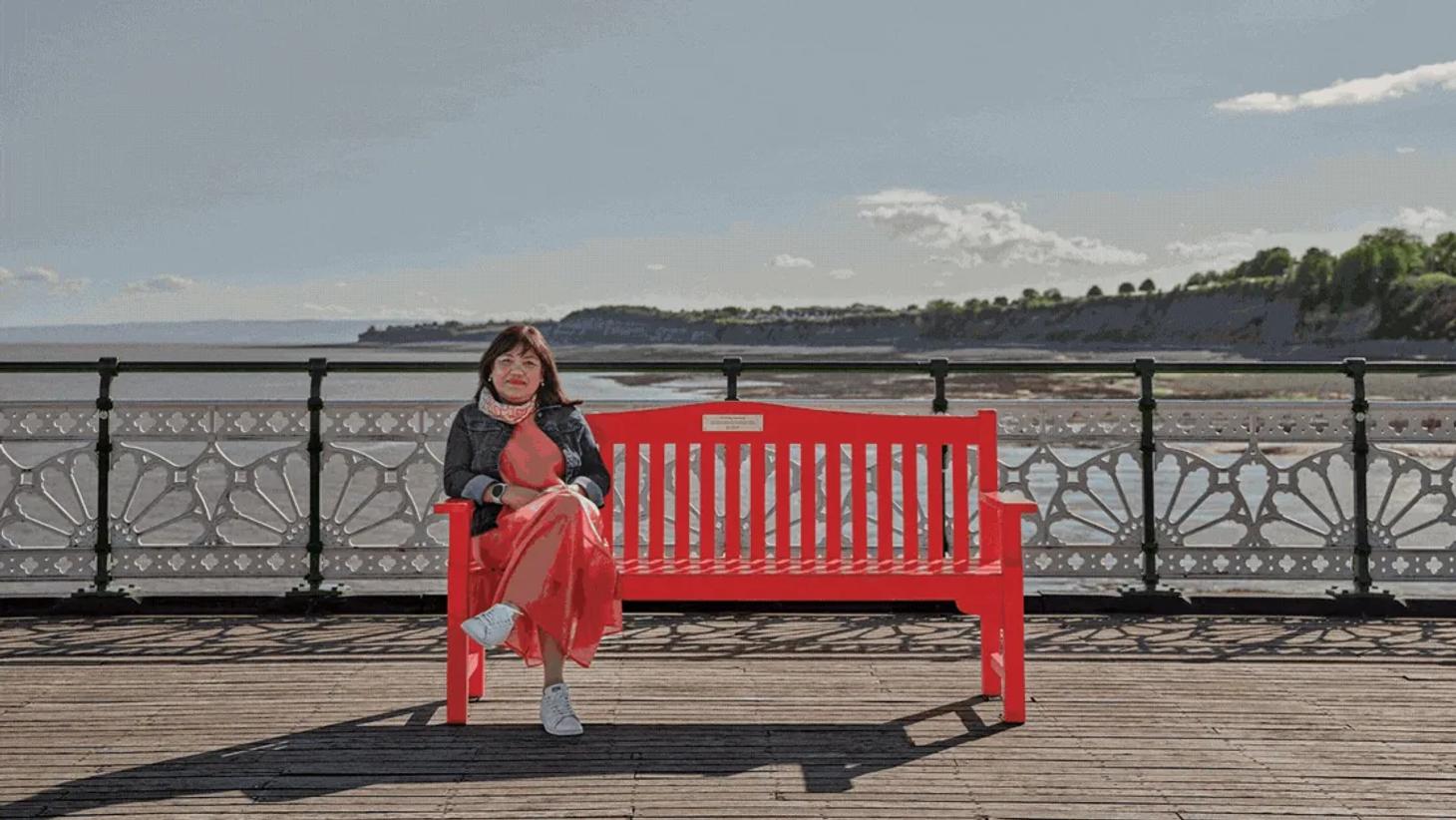
Seat at the Table, below, is an example of an ambient advertising campaign from us.
Stunt advertising
A stunt stages a moment designed to be witnessed and filmed: a protest, a performance, a prank with a point. The live audience is small by design, because the footage is the product. Stunts carry the biggest upside and the biggest risk, since a misread crowd or a missed cue becomes the headline, or a You've Been Framed clip.
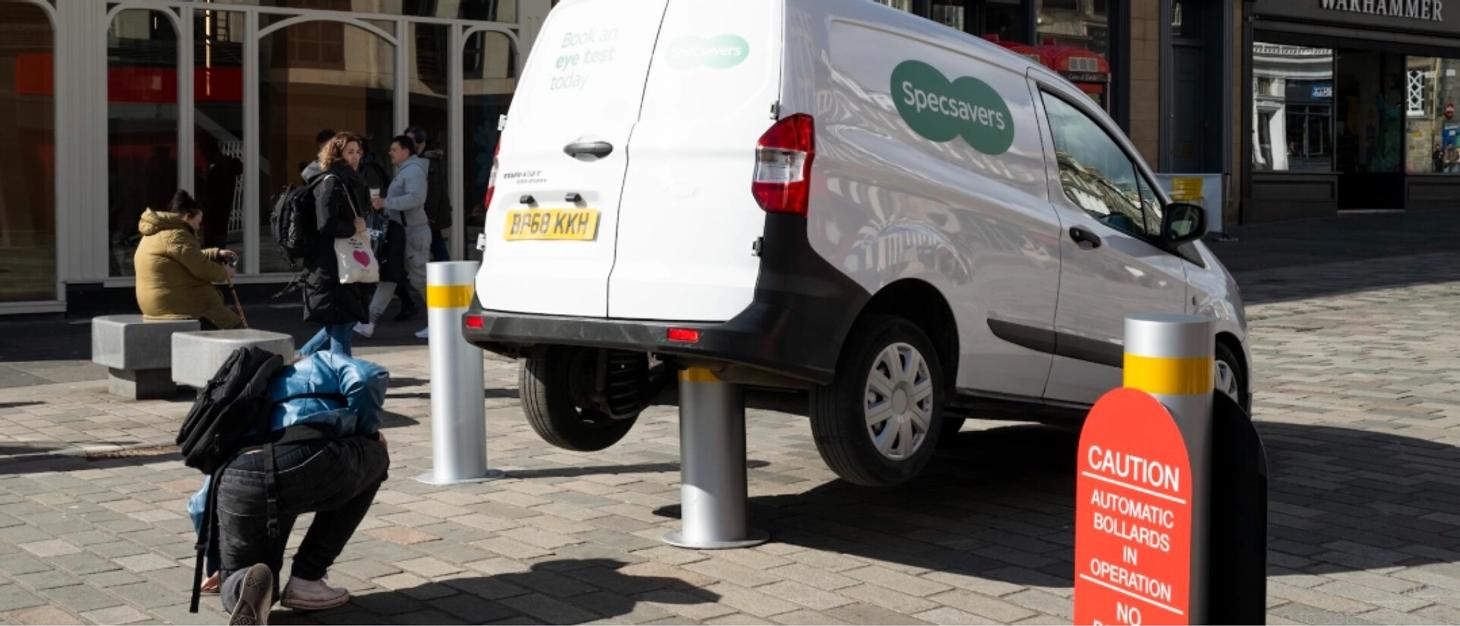
In March 2024, Specsavers parked a van on a bollard, or appeared to, on Castle Street in Edinburgh. The brand told LBB Online the stunt earned more than 150 million media impressions.
Street marketing
In street marketing, public space is the canvas: posters, projections, chalk, tearaway flyers and branded vans. It's the most accessible form of guerrilla advertising and the most regulated, because every street belongs to someone. Done well, it feels like it was planted by locals.
London venue KOKO went this way in September 2026, pasting cryptic takeaway-menu-style posters with mystery phone numbers across the city's walls.
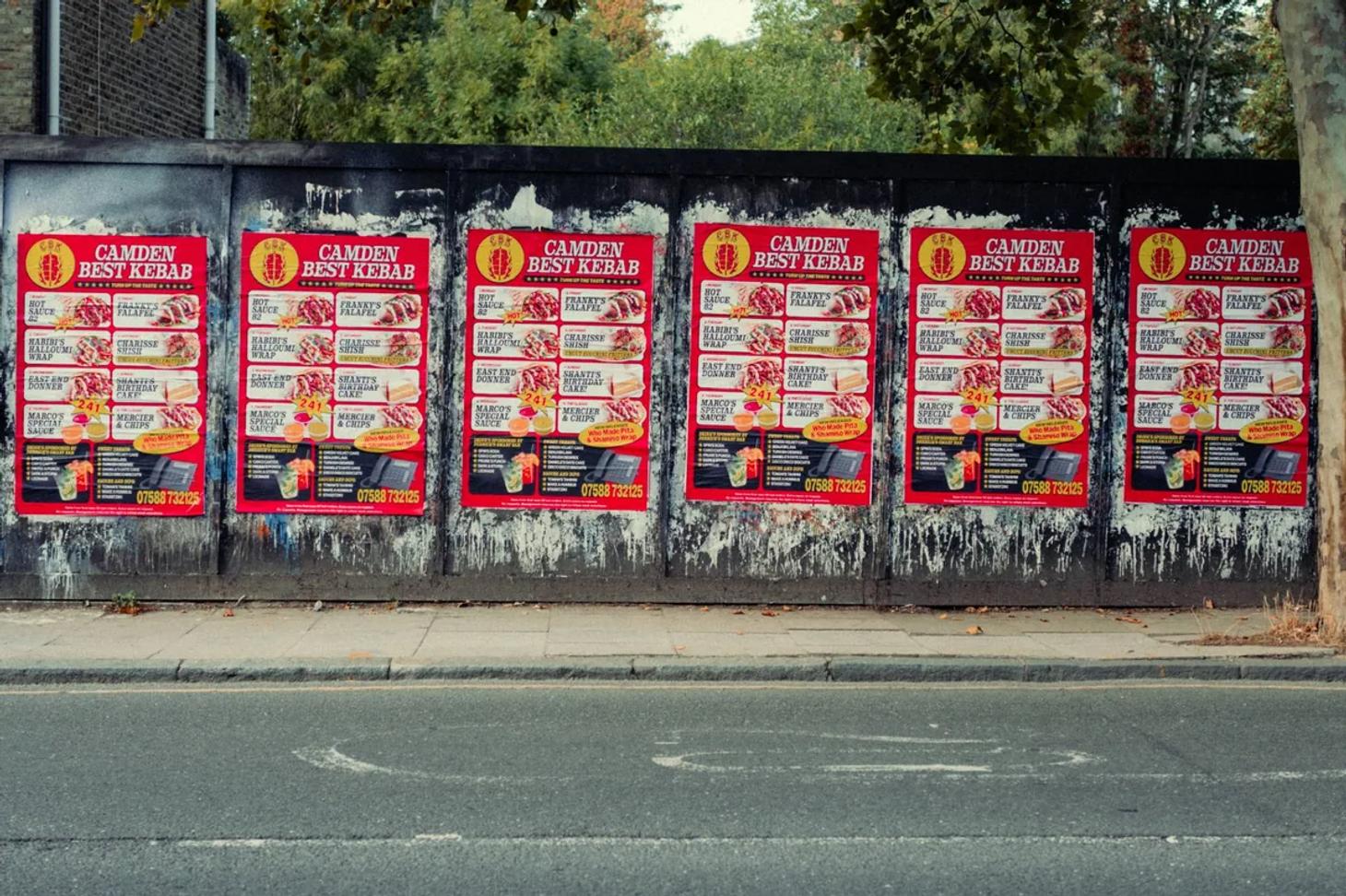
Killed Saving Lives, below, is our street example.
Ambush marketing
An ambush hijacks attention around someone else's event or launch; a big enough news story does the same job. Major sporting events are the classic target, and a live cultural conversation makes a sharper one.
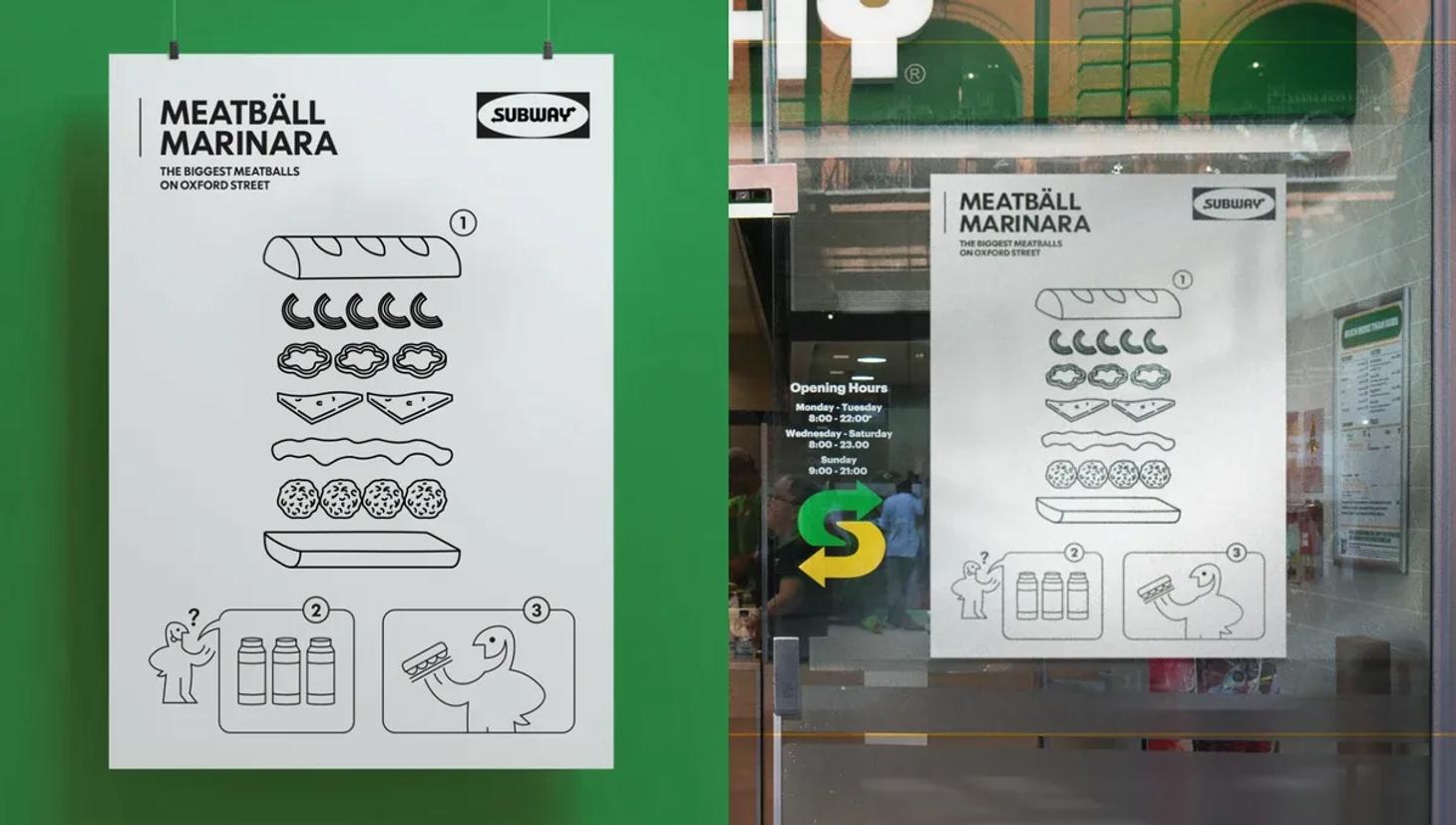
In May 2025, Subway gatecrashed IKEA's Oxford Street opening by handing shoppers IKEA-style vouchers for a free "Meatbäll Marinara" sub.
OilyFans, below, is our ambush.
Event organisers police ambush hard, so check contracts and venue restrictions before going anywhere near Wembley on match day.
Undercover, viral and grassroots
Stealth or undercover marketing hides the ad inside something that looks organic, while viral and grassroots work seeds an idea and lets people carry it. Both live or die on honesty. Stealth that tips into deception breaches UK advertising rules, and faked grassroots backing, known as astroturfing, tends to get found out.
Ocean Spray went undercover in December 2025, putting Secret Santas in three South London chicken shops to hand free cranberry sauce to anyone who said "Ho ho ho".
Larry 4 Leader, below, is our grassroots example, carried by the @Number10Cat parody account.
How to plan and build a guerrilla advertising campaign
Our five-stage guerrilla build is the process behind every guerrilla campaign we make. It needs three inputs: a clear objective, a realistic budget and a tension people already feel. It produces one execution built to be captured and shared, plus a permissions plan and a measurement plan agreed before launch.
The stages to plan and execute a guerrilla advertising campaign run in this order:
- Find the tension. We look for the gap between what people are told and what they experience, such as record oil profits during a cost-of-living crisis. The idea has to put that gap in plain sight.
- Pick the ground. Location is half the idea. We choose the site and the timing together, news moment included, because timing decides whether a great execution travels.
- Clear the risks. We check site ownership, council consent, event restrictions and every way the idea could be misread. Our round-up of PR stunts gone wrong shows what skipping this stage costs.
- Budget for the capture. Production, crew, photography, PR and paid social seeding sit in the budget from day one. Footage is what turns a moment into a campaign.
- Agree the measure. We set targets for coverage, social conversation, site traffic or sign-ups before launch, then report against those numbers.
When a guerrilla campaign falls flat, the cause is usually stage three or four, or the British weather.
Guerrilla advertising in action: Campaigns we've made
Guerrilla thinking runs through our work, and these campaigns show its range. They span a memorial wall, a satirical billboard hijack, a self-initiated political spoof and a charity film that moved a war onto British streets. Each started with a tension and was built to travel far beyond the people who saw it.
MAP, Killed Saving Lives
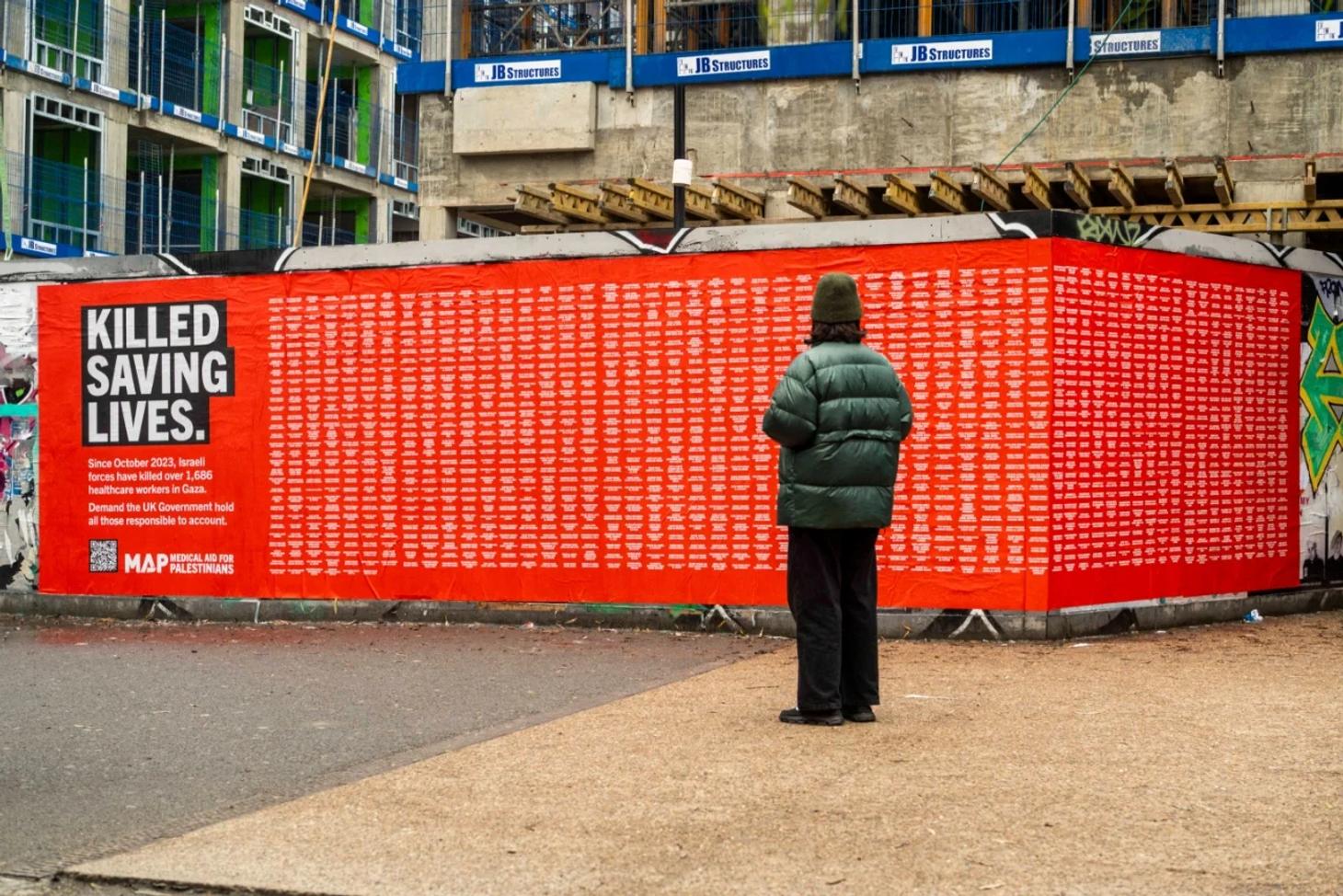
Medical Aid for Palestinians (MAP) asked us for an intervention that would break through public fatigue about the destruction of Gaza's health system. We built Killed Saving Lives, a 10-metre memorial carrying 1,686 names, each one a Palestinian health worker killed since October 2023.
We verified every name with MAP's teams in Gaza and the West Bank and in the UK, then installed the memorial outside Hackney Wick station in 2025.
OilyFans
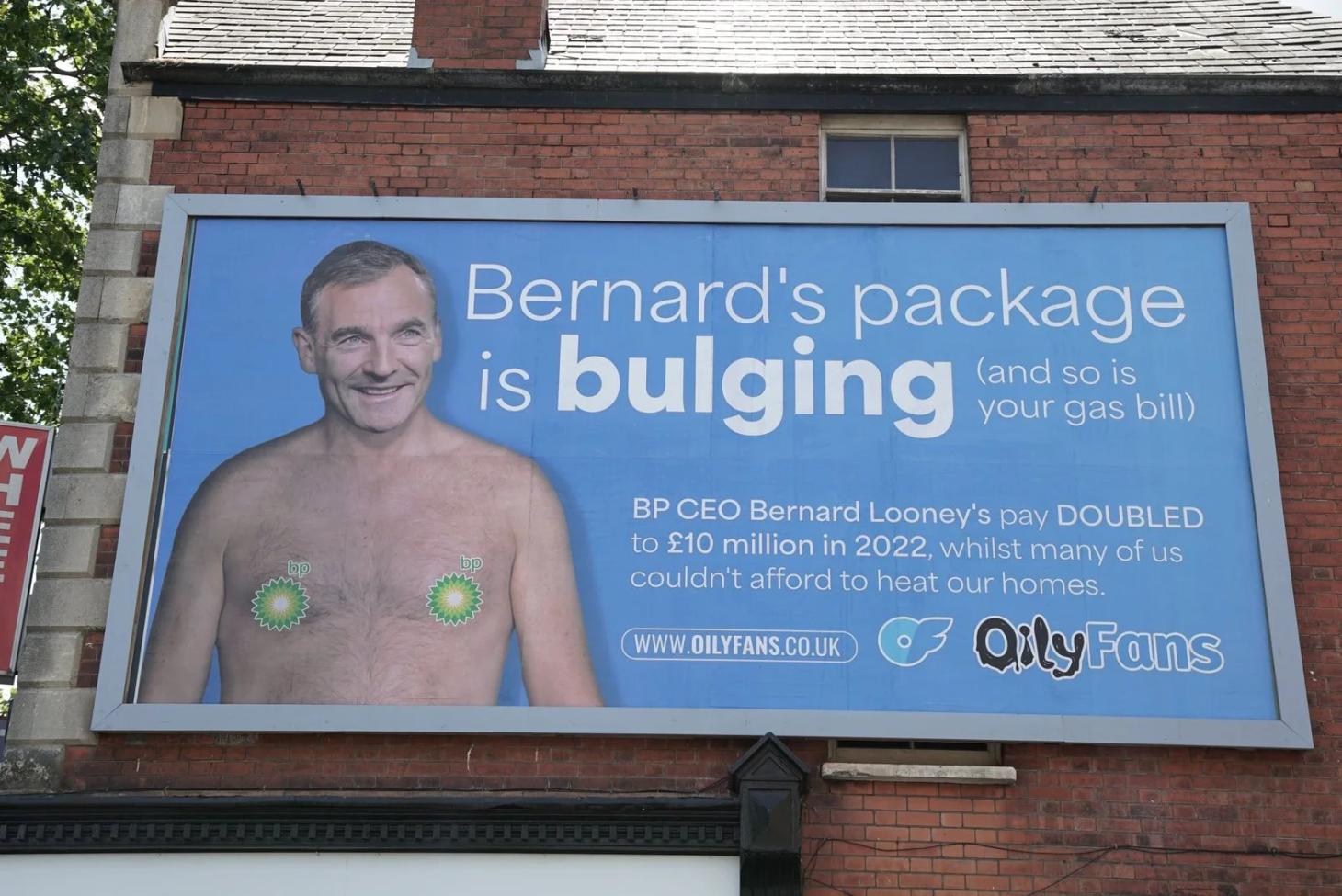
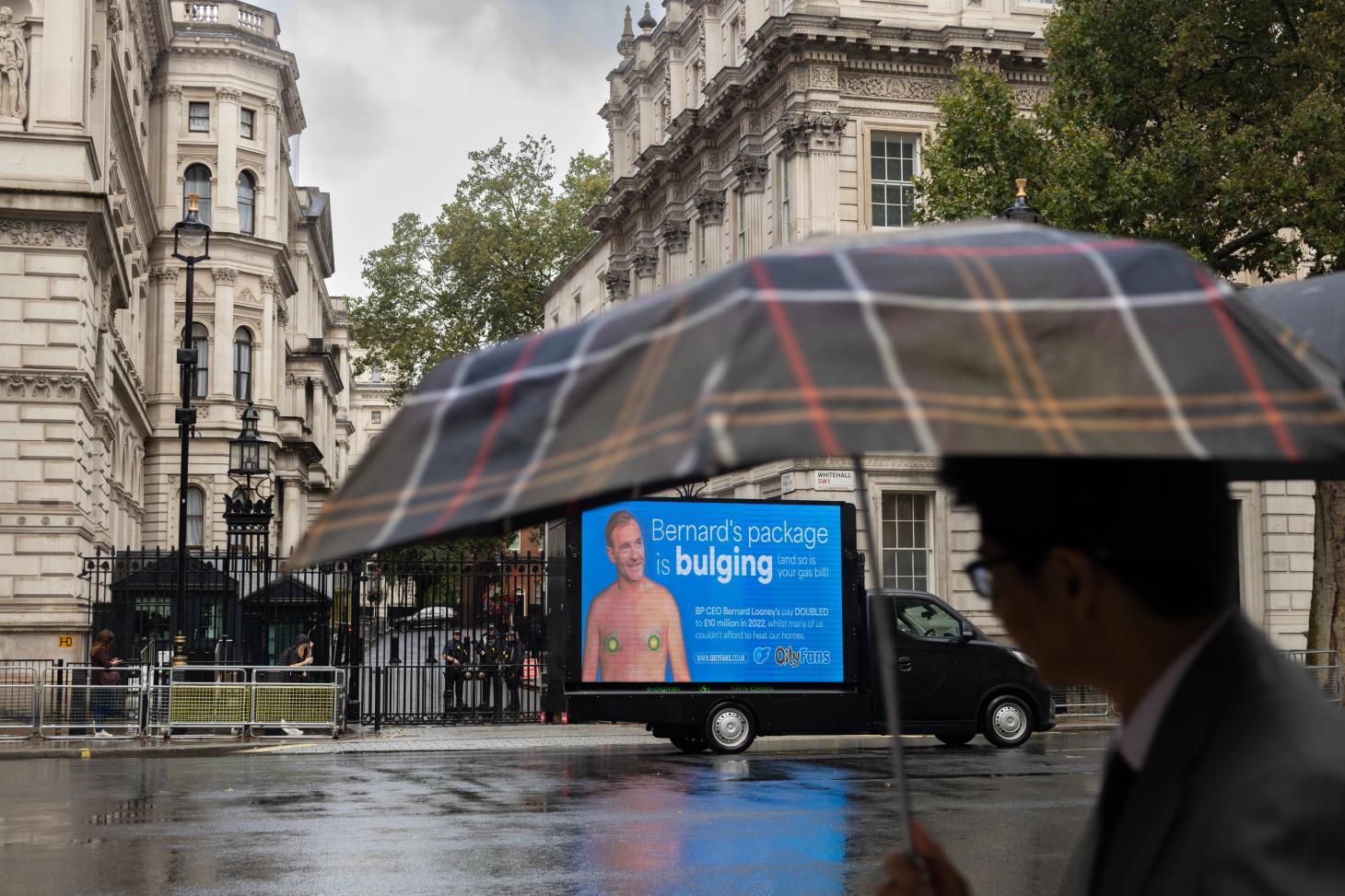
In mid-2023, as oil giants lined up record profits during a cost-of-living crisis, Global Witness gave us five days to respond. We made OilyFans, a parody of an OnlyFans creator's viral London billboards, placed on the same sites and starring a topless, photoshopped oil boss alongside his pay packet.
A digital ad van circled Downing Street on the day the Net Zero minister met energy giants. The campaign passed 700,000 impressions on X.
Larry 4 Leader
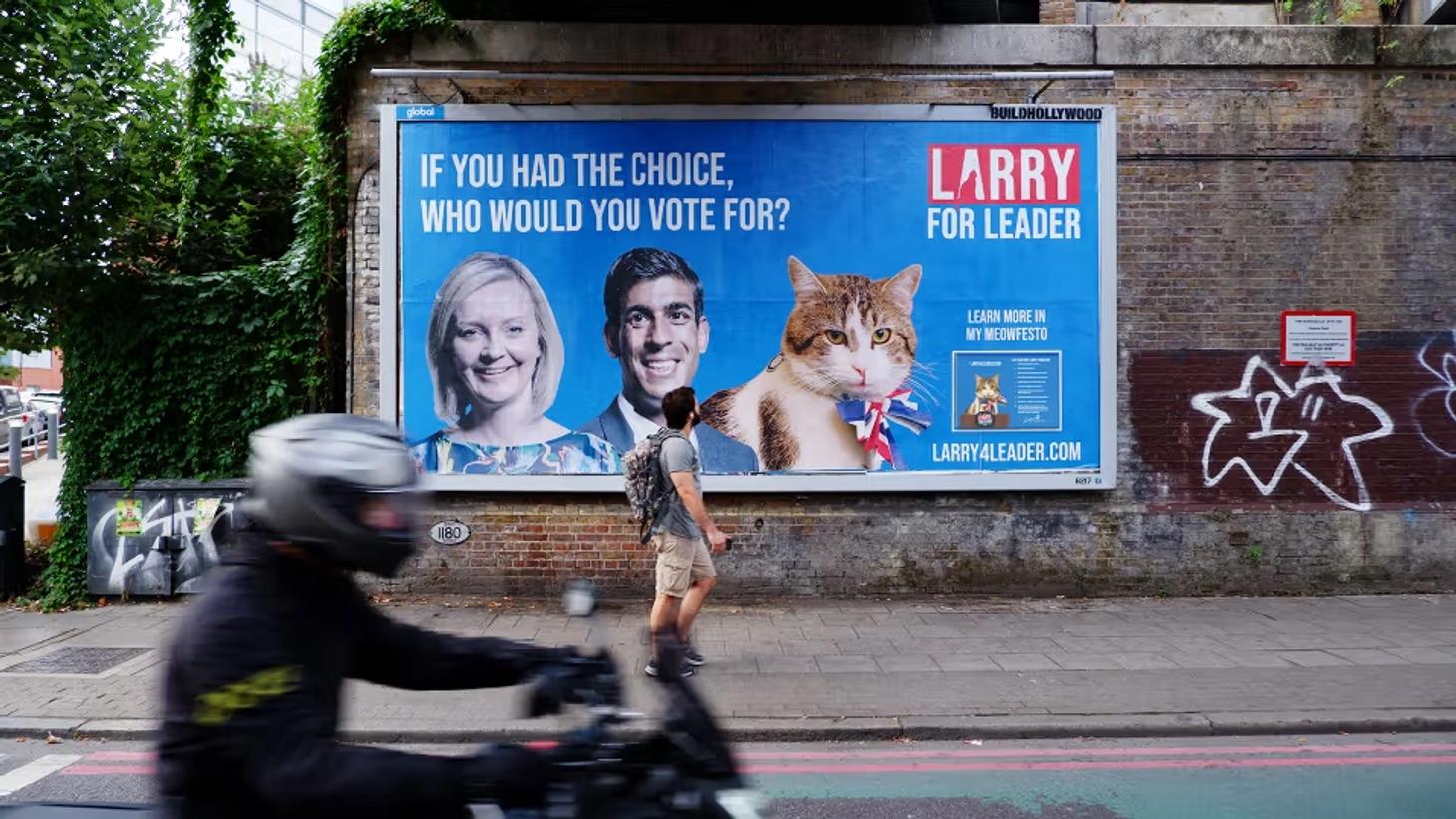
In 2022, just 160,000 Conservative Party members were choosing the next prime minister, and the rest of the country could only watch. We launched Larry 4 Leader, a spoof campaign putting Larry the Downing Street cat forward as the people's candidate.
Four London billboards, two with tearaway "meowfestos", drove more than 30,000 visits to the campaign microsite. The cat picked up 70-plus press features worldwide.
YouTube, Seat at the Table
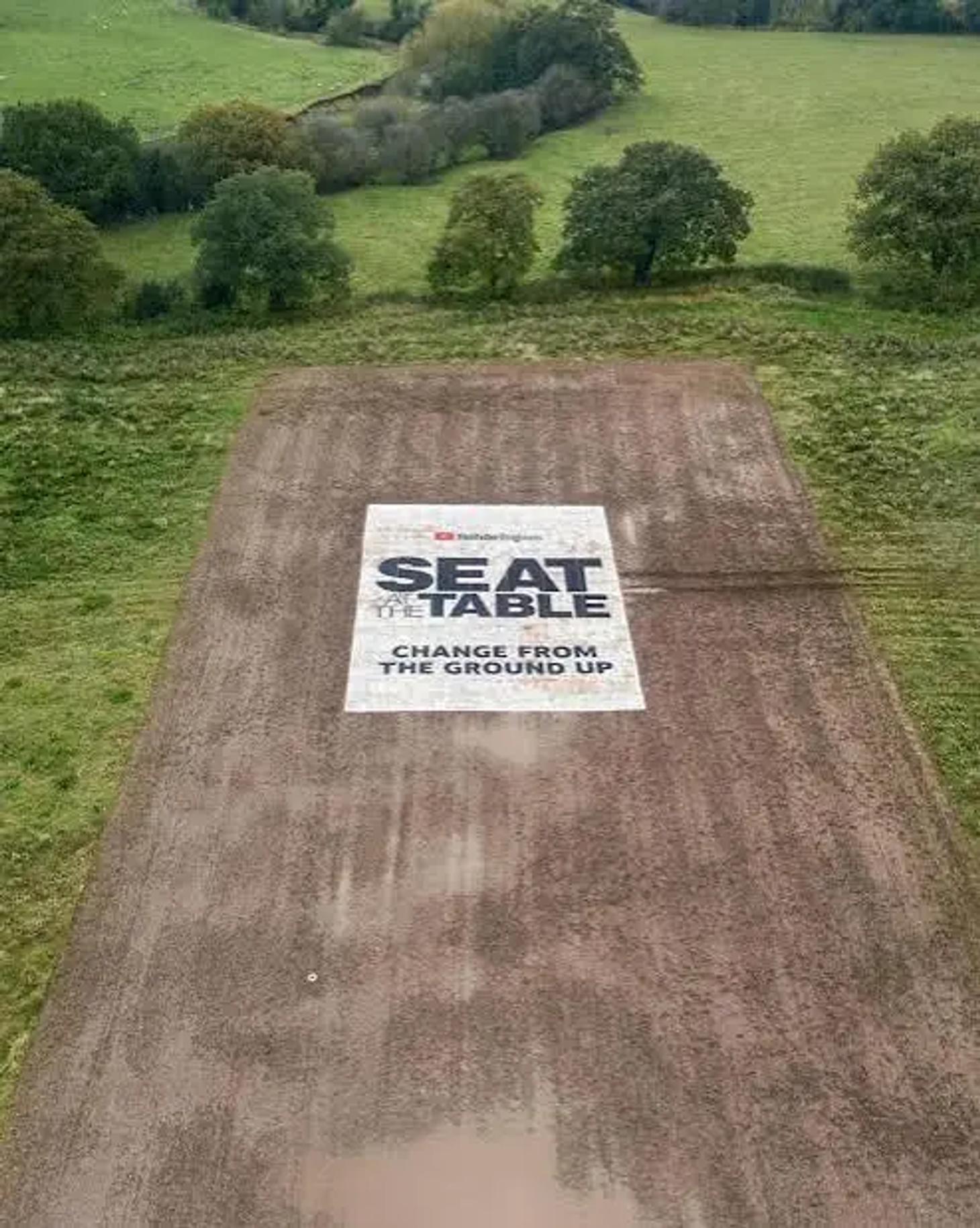
Ahead of COP26 in 2021, we partnered with YouTube Originals and Cheshire Wildlife Trust to put climate hope in front of Gen Z. We made Seat at the Table, a 500-square-metre poster made entirely of seed paper and laid across reclaimed farmland in Cheshire.
Then the poster grew. The campaign reached more than 3 million people through influencers and helped make YouTube Originals' most viewed UK show.
Where guerrilla advertising came from
The playbook behind guerrilla advertising comes from Jay Conrad Levinson's 1984 book Guerrilla Marketing: Secrets for Making Big Profits from Your Small Business. It showed smaller businesses how to win on imagination and a small budget. Campaign's history of Levinson's Guerrilla Marketing notes he'd been a creative director at Leo Burnett in London first.
His game plan was blunt: skip the expensive campaigns and use unconventional tactics, making the work shocking, funny, clever or outrageous enough that people want to talk about it. He also insisted the product had to deserve the buzz. "Marketing is not an event but a process," Levinson said.
Four decades on, George Orwell's Big Brother turned out to be everyone with a phone, which multiplies the reach of every physical surprise.
Common misconceptions about guerrilla advertising
The best-known guerrilla campaigns make the format look effortless, which is where the myths start. The work that travels usually rests on weeks of planning, consents and a paid plan for capture. These are the misconceptions we hear most often from brands weighing up a first campaign:
- It's free. It might be cheaper than a national TV buy but it still needs a proper budget. Cut the permissions or crew budget, or skimp on PR, and the stunt fails. Save the "it'll cost nothing" pitch for the Dragons' Den.
- It always goes viral. Reach is high-variance. The same YouGov data shows only 3% of Britons have posted about a brand on social media after seeing an out-of-home ad, so sharing has to be designed in.
- It's just stunts. Stunts are one type among several. Ambient, street, ambush and grassroots work often run longer and carry less risk.
Frequently asked questions about guerrilla advertising
Is guerrilla marketing illegal?
Running a guerrilla campaign is legal in itself, but plenty of executions break the law. GOV.UK's planning guidance on advertisements is clear that displaying an advertisement without the right consent is a criminal offence in England, which makes unauthorised posters, projections and flyposting a legal risk.
The content is regulated too. The UK's CAP Code, the rule book for non-broadcast advertising, requires marketing to be clearly identifiable as marketing, which catches undercover campaigns that pretend to be something else. Consider the council part of your target audience.
Is guerrilla marketing still a thing?
Street-level guerrilla work is still going strong, and smartphones have made it more potent. YouGov's figures show 13% of Britons have taken a photo of an out-of-home advert on their phone, turning one physical moment into shareable content. A street poster stays in view for everyone who walks past, whatever ad blocker they run.
How much does a guerrilla advertising campaign cost?
Guerrilla campaign budgets come down to three parts: the build, the permissions and the amplification. The biggest variables are the scale of the build, the site and its consents, and crew on the day. Then comes the PR, photography and paid seeding that carries one moment to a national audience.
Treat the first quote like a builder's estimate.
What is a guerrilla marketing example?
A classic guerrilla stunt is UNICEF's Tap Project, which set up dirty water vending machines in Times Square to raise money for children living without clean water. The water stayed in the bottles while the donations came in, and the machines made a distant crisis tangible on one of New York's busiest corners.
Pick your battlefield
Brands and charities with something true to say, and the nerve to say it somewhere unexpected, get the most from guerrilla advertising. If you've got a tension worth exposing and a budget smaller than the big spenders', the next question is where your campaign should land.
We build guerrilla work for brands and charities, including memorial walls and billboard hijacks. Explore our earned media services to see how we turn one sharp moment into national coverage.
Put the kettle on and browse our campaign case studies for the full range of work built to be talked about.