




Regenerative agriculture targets are going backwards. FAIRR’s "Ambition to Credibility" analysis found the share of major food companies setting quantified targets fell from 35% to 28% between 2023 and 2026. Only 4% tied those targets to outcomes anyone could actually measure.
The ambition is retreating while the marketing races ahead. That’s the gap brands keep falling into, and regulators on three continents have started fishing them out.
The six examples below show exactly where the claim outran the evidence, plus a credibility check to run before yours does the same.
Regenerative food advertising gone wrong in brief
- Regenerative and net-zero food claims are now drawing binding legal and regulatory action across the US, EU and UK, not just NGO criticism.
- FAIRR’s 2026 findings show the share of assessed companies setting quantified targets falling from 35% to 28%, with only 4% outcome-based.
- A Swedish court banned an Arla net-zero advertising claim outright, with a fine attached to any repeat.
- JBS and Tyson both settled US cases in 2025 that forced them to drop or restrict climate claims, according to the New York Attorney General and Earthjustice respectively.
- The UK’s ASA ruled against Red Tractor over environmental assurance that inspection data did not support.
- The pattern is consistent: the claim outran the evidence, and someone with subpoena power noticed.
Why regenerative claims keep failing
Regenerative claims fail for one reason: the word doesn’t mean anything in law, so brands write their own definition and then get caught missing it. The ASA said as much in its November 2024 guidance: "regenerative" has “no legal universally agreed definition”, so every claim rests entirely on the advertiser’s own version of events.
That version tends to run well ahead of the field. The marketing scales up while the substance behind it thins out, and FAIRR’s analysis found most of what gets pledged is acreage enrolled, not outcomes measured. Enrolled land and delivered results are not the same thing, and a regulator will always read a claim against the difference.
The scrutiny has changed shape, too. What used to be an NGO press release is now a court order or an attorney general settlement, with shareholder resolutions piling on behind them, demanding the outcome data brands would rather keep quiet.
A claim that sounds visionary in a deck reads like a confession once the enforcement letter lands.
Where regenerative claims have gone wrong
Six campaigns show the same fault line, spanning self-reported claims, investor pressure and binding legal action.
Nestlé
Nestlé’s regenerative and net-zero story is carrying more weight than its own numbers can hold. The Corporate Climate Responsibility Monitor 2023, analysed by Changing Markets, projected the company’s plan would land at just 16 to 21% emissions reductions by 2030, against a science-based target of 50%. The headline promise and the modelled outcome are not in the same range.
The transparency problems don’t help the case. Nestlé’s own 2025 Dairy Plan Report claims a 26% net reduction in dairy value-chain emissions and 34% of dairy sourced from farms "adopting" regenerative agriculture in 2025, a claim DairyReporter has since put under scrutiny.
Notice the word doing the heavy lifting: "adopting." It commits a farm to precisely nothing measurable. The 26% figure quietly blends farm-level cuts with value-chain removals, which flatters the headline without technically lying.
The lesson: build a claim on a soft verb and a blended metric, and you’ve built a claim someone else gets to unpick. Nestlé handed critics both tools for the job.
General Mills
General Mills didn’t need a regulator. Its own shareholders did the job. In October 2025, 28% backed a resolution, filed by As You Sow, demanding the company disclose the pesticide-reduction outcomes behind its regenerative agriculture programme.
More than a quarter of your own investors asking for the receipts isn’t a fringe protest, it’s a vote of no confidence with a paper trail. It means the people closest to the numbers don’t buy the story the marketing’s telling. If a programme’s good enough to put in a press release, it should be good enough to show the people who actually own the company.
The lesson: when your shareholders start voting for disclosure, your regenerative claim has already outrun your evidence, and the vote is the story now, not the campaign.
Cargill and PepsiCo
Cargill and PepsiCo both learned that a big acreage number only impresses people who don’t ask what’s happening on the acres. Cargill set a 10-million-acre target for 2030. By 2024 it had deployed only 1.1 million, on the sector figures compiled by Trellis.
PepsiCo’s story rhymes. Its original 7-million-acre target got raised to 10 million on the way to landing at 3.5 million acres in 2024, per the same reporting. Raising the target after missing it is a classic cover up tactic. Move the goalposts far enough and the original miss disappears from the story. Nobody’s fooled.
Acres enrolled is the number that makes the press release. Acres delivering a measured outcome is the number that matters, and the gap between the two is exactly where the claim gets picked apart.
The lesson: an acreage pledge comes with a deadline attached, and the shortfall is public record the second the year closes.
Arla
Arla is proof a regulator will actually pull the trigger. In February 2023, the Swedish Patent and Market Court banned Arla’s "net-zero climate footprint" advertising outright, with a SEK 1 million fine sitting behind any repeat. Not a note asking them to reword it. A ban, with a price tag on ignoring it.
The scale problem behind the claim is almost funny. A peer-reviewed PLOS Climate study found Arla’s "regenerative agriculture pilot" covered 24 farms, or 0.0019% of its total global operations. That’s not a pilot supporting a company-wide promise. That’s less than a rounding error wearing a promise’s clothes, and the court saw right through it.
The lesson: the gap between a pilot and a portfolio is exactly the gap a regulator measures, and Arla’s was wide enough to lose the case in.
JBS and Tyson
Big Meat had two chances to defend its climate claims in court. It took neither. In November 2025, the New York Attorney General secured a $1.1 million settlement from UK meat wholesaler JBS over its "Net Zero by 2040" claim, which an OAG investigation found the company had no actual plan to hit.
JBS now has to stop making unsubstantiated environmental claims and report to the OAG every year for three years.
Tyson folded on the same ground. It agreed to drop "net-zero" and "climate-smart beef" claims, under a settlement filed in DC Superior Court, for five years unless it can independently verify them, per Earthjustice.
Independent verification was the bar neither company could clear before they started advertising the outcome.
The lesson: "net zero" and "climate-smart" are now enforcement triggers in the meat aisle, not marketing flourishes. If you can’t independently verify a claim, you don’t get to run it.
Red Tractor
Red Tractor’s track record proves a little red logo isn’t a very good shield. In October 2025, the ASA ruled against Assured Food Standards, trading as Red Tractor, over environmental claims its own scheme couldn’t back up. River Action UK, which brought the challenge, didn’t dress it up. They called it out as straightforward greenwashing.
The inspection data explains why. Environment Agency figures cited by River Action UK showed 4,353 of 7,353 inspections, nearly 60%, turned up at least one breach between January 2020 and July 2025. That’s an assurance badge promising environmental standards while sitting on a near-60% breach rate.
The lesson: a certification logo is only as credible as the audit behind it, and both the ASA and the inspection record will check your working.
Our regenerative claim credibility checking framework
Before any regenerative or sustainability claim goes live, you need to run it through the same three questions a regulator will ask. Skip this, and you might just end up as the next case study on this list.
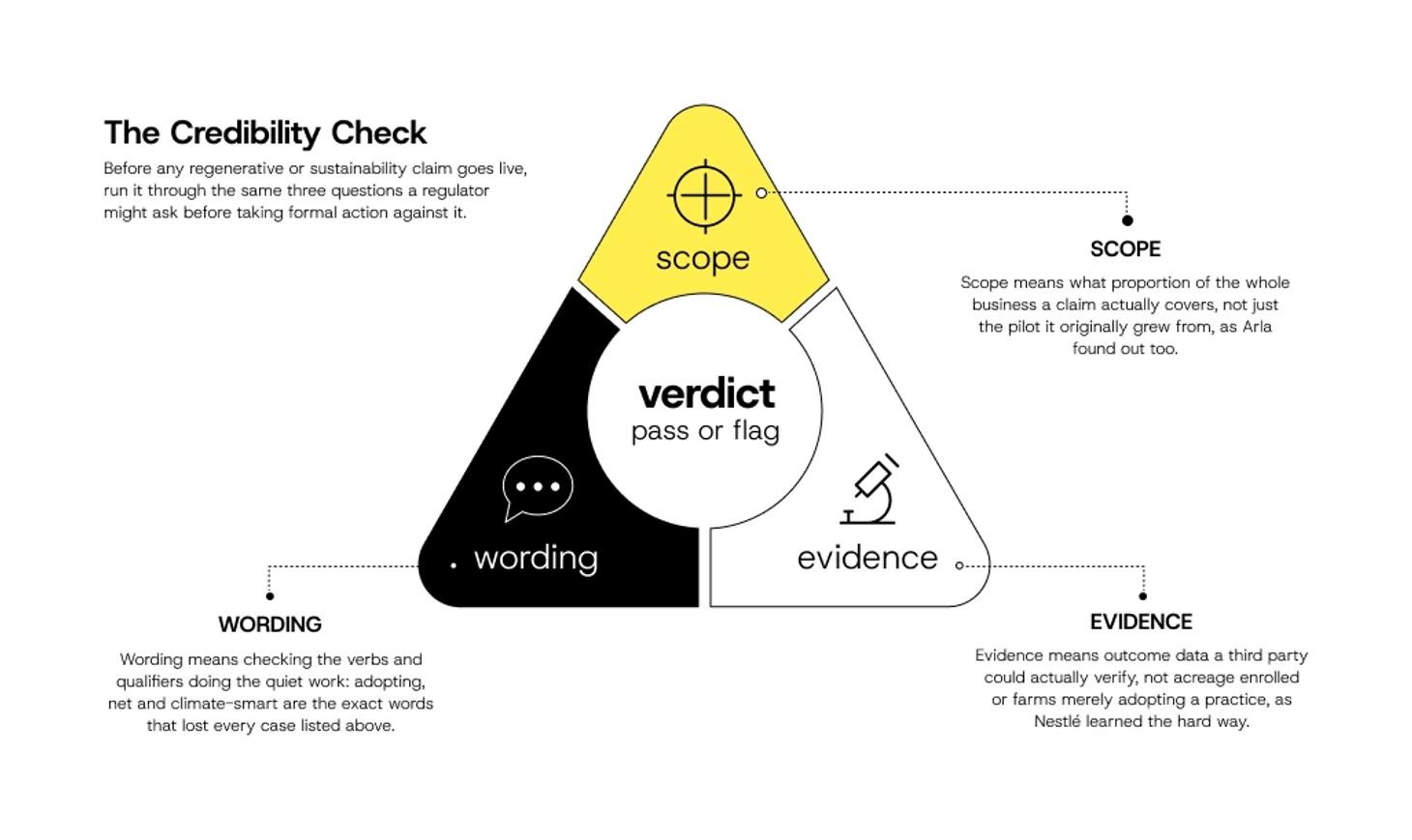
Don’t Panic’s Regenerative Food Claim Check:
- Is the scope accurate? What proportion of the business does the claim actually describe? Not the pilot it grew from, the whole operation it’s speaking for.
- Do you have evidence? Is there outcome data a third party could actually verify, or is it acreage enrolled and farms "adopting" a practice, which is a fancy way of saying nothing yet?
- Is it worded carefully? Check the verbs and qualifiers doing the quiet work, because "adopting," "net" and "climate-smart" are the exact words that lost every case above.
Hold each answer up against this list. Does the scope match reality, or is it Arla’s 24 farms wearing a company-wide promise? Does the evidence survive someone else reading it, or is it Nestlé’s blended metric waiting to be unpicked? Would the wording survive an ASA ruling or an attorney general’s letter, or is it JBS’s net-zero claim in different branding?
A claim that clears all three is one you can actually stand behind. A claim that fails any of them isn’t ready, and running it anyway just books your slot on next year’s list.
Common questions on regenerative food advertising
Can regenerative farming escape the ESG backlash?
Regenerative farming can outlast the ESG backlash, but only if the claims behind it are backed by verifiable outcomes rather than enrolment figures. The backlash isn’t aimed at the practice, it’s aimed at brands who talk the talk but don’t walk the walk. The ones reporting measured results, scoped honestly, tend to walk straight past the backlash while everyone else gets caught in it.
What does regenerative mean on a food label?
Right now, "regenerative" on a food label means whatever the brand printing it decides it means, because there’s no legal or agreed definition to hold it to. The ASA has confirmed there’s no standard behind the word, which is exactly why claims built on it keep drawing scrutiny. Treat an unqualified "regenerative" label as a marketing line, not a certified standard.
What is the regenerative food trend?
The regenerative food trend is major food companies marketing soil-health and net-zero credentials tied to farming practices. It’s grown fast enough that regulators and investors are now testing whether the claims behind it actually hold up.
Why doesn’t everyone do regenerative farming?
Not every producer has adopted regenerative farming because it takes years to show measured results, costs money upfront, and doesn’t verify itself on a marketing team’s timeline. The practices are slow and depend on local conditions by nature. That mismatch, farming reality against campaign deadlines, is exactly what produces the claims that collapse later.
Check your claim before someone else does it for you
The through-line across all six cases is simple: the claim moved faster than the evidence, and somewhere a court, a regulator or a shareholder base was keeping score.
That environment is only tightening. US settlements, EU court bans, and UK ASA rulings have arrived inside two years, and the investor pressure sitting behind them is still building.
The next brand to overstate a regenerative claim will not be arguing with an NGO. It will be answering to someone who can compel disclosure.
The safer route is also the more credible one: scope the claim to what the farming can prove, and check it before it runs. For the positive playbook on getting regenerative marketing right rather than wrong, read our guide to how to market regenerative farming the right way. This is exactly the kind of claim Don’t Panic pressure-tests before a campaign goes live. Start with our regenerative agriculture expertise.