



Two in five green claims made online could mislead the people reading them, by the Competition and Markets Authority's own count. For anyone marketing regenerative farming, that is the number you are now selling against.
Regenerative farming is the hardest green claim a brand can make. It promises healthier soil and carbon pulled back into the ground, and every word of that can be measured. What can be measured can be checked.
Get it right and you earn trust that ironically doesn’t grow on trees. Get it wrong and you hand a regulator, a journalist, or a sharp-eyed customer the rope.
This is a practitioner's guide to marketing a regenerative-farming proposition without tripping the greenwashing alarm: the UK rules you now operate under, and the evidence a claim needs to survive them.
Marketing regenerative farming in brief
- Regenerative farming marketing lives or dies on evidence: soil, carbon, and supply-chain proof that holds up to regulatory and consumer scrutiny.
- The CMA Green Claims Code is the’s UK guardrails for marketing regenerative farming: environmental claims must be truthful, clear, complete across a product's full lifecycle, and substantiated with data.
- Since 7 April 2025, the CMA can act on misleading claims directly and fine a business up to 10% of global turnover, without going to court first.
- A regenerative claim outruns a generic "sustainable" one because it names measurable levers: soil organic matter, carbon sequestration, and supply-chain practice.
- Evidence first, adjective second: lead with the number, not the word "natural".
- British exemplars already exist. Yeo Valley publishes its own soil-carbon data; Wildfarmed builds its grain claim on farming practice, not packaging language.
- Purpose is the foundation. Proof is the product.
Why marketing regenerative farming is harder than it looks
Most green marketing fails quietly, in the gap between what a brand says and what it can show. Regenerative farming widens that gap, because the words carry scientific weight that the marketing rarely backs.
Claiming you’re "sustainable" could survive on vibes. The same can’t be said for "regenerative".
The term claims active improvement: soil that holds more carbon this year than last, biodiversity that returns, water that runs cleaner off the farm. Each of those is testable, which means each can be proved wrong.
Say a farm regenerates soil and you have invited someone to measure it. If the data is not there, the claim is greenwashing, whether you meant it or not.
The category also sits inside a genuine scientific argument. Yields, carbon permanence, and whether the model scales are all live debates among agronomists. Marketing that pretends the debate is settled reads as naive to the people who know the field.
None of this makes regenerative farming a bad story. It makes it a demanding one. The brands that win treat the difficulty as the moat.
Is marketing regenerative farming just greenwashing?
Not when the evidence backs the claim. Marketing regenerative farming becomes greenwashing only when the claim outruns the proof. A "regenerative" badge backed by published soil-carbon data, named practices, and third-party measurement is legitimate; the same badge with nothing behind it is greenwashing, and now an enforceable legal risk.
The line is substantiation, not intention. A brand can believe its own story and still mislead, because the CMA Green Claims Code judges a claim by what the evidence supports, not by what the brand hoped to convey.

Under the new regime the test is no longer whether you believed the claim, but whether you can show the working behind it. If that worries you (and it should), you can use the guardrails below to turn that test into a method you can repeat.
Five principles for marketing regenerative farming the right way
Five principles move a regenerative farming claim from aspiration to evidence. Each one closes a gap that gets brands into trouble.
Lead with evidence, not adjectives
The first rule of marketing regenerative farming: no adjective survives without a proof point. "Regenerative", "natural", and "sustainable" are claims, not descriptions, and every one needs evidence attached in the same breath.
Swap the adjective for the measurement. Instead of just saying "regeneratively farmed" and stopping for lunch, show the soil organic matter gain, the carbon figure, the number of farms, the year the data was taken. A specific number is harder to write and far harder to dispute if you can prove it.
The CMA's six-principle test sets the bar plainly. Claims must be:
- Truthful
- Clear
- Free of important omissions
- Fair in any comparison
- True across the full lifecycle
- Substantiated.
Read those as a creative brief, not a legal afterthought.
Evidence-led copy reads as confident. Adjective-led copy reads like you’re hedging, which is exactly what a sceptical buyer is scanning for. Give them numbers before they think to ask “Based on what?” and you’ll earn their trust.
Name the standard before the regulator does
Make no mistake: vague green language is now a direct legal liability. The CMA can enforce consumer law itself and fine a business up to 10% of global turnover for misleading claims, without first going to court.
So name your standard before anyone asks. State the practice, the certification, or the measurement framework your claim rests on, and link to it. A claim that cites its own basis is far harder to challenge than one that floats free.
UK policy works in your favour here. The Department for Environment, Food and Rural Affairs (DEFRA) runs a Sustainable Farming Incentive that pays farmers in England for specific land-management actions, which gives a regenerative claim a recognised reference point rather than one you invented yourself
Precision protects you. The more exactly you describe what regenerative means for your farm, the less room a regulator has to read it as a vague boast.
Sell the system, not the symbol
A leaf icon and a green palette are not evidence. Regenerative farming is a system: cover crops, reduced tillage, rotational grazing, restored hedgerows, cleaner water leaving the land. Sell the system, and the symbol becomes redundant.
The credibility levers are specific and testable: soil health, water quality, carbon permanence, the state of the supply chain. Make the science the story, because command of the detail is what a sceptical buyer actually reads as proof.
A buyer who fears greenwashing is reassured by specifics about the mechanisms, not so much fancy visuals. "We rebuilt soil organic matter through cover cropping and rotation" lands harder than any amount of pastoral wide shots.
Be honest about the hard questions
The contentious questions are always the most interesting ones, and trying to duck them costs you credibility. Can regenerative farming feed the world at scale? Is every regenerative claim genuinely better for the climate?
The honest answer is often that the evidence is still being built. So say that, basically.
A brand that acknowledges the open debate comes across like it understands the field. A brand that claims regenerative farming has settled every question sounds like it’s on the hustle.
This is where a changed supply chain separates the serious from the opportunist, the brands that altered how they farm from the ones that altered their packaging. We dig into that line in our guide to how purpose-driven brands earned their position rather than borrowed it.
Facing the hard questions is not a weakness in the campaign. It’s the clearest signal that the claim is real, and you’re not talking out of your arse.
Make the farmer the hero, not the brand
The real work happens in fields, not boardrooms. In the purpose-led food work I have been part of, the most credible regenerative marketing puts the grower at the centre: the people changing how they work the land, the risk they carry, the years it takes for soil to recover.
A farmer explaining a practice carries an authority no brand voice doc can manufacture. It shifts the claim from corporate assertion to lived account.
It also keeps you out of trouble. Document a real farm, a real method, a real result, and your marketing becomes a record rather than a promise.
How do you prove a regenerative-farming claim?
The best way to prove a regenerative-farming claim is with measured, published, and ideally third-party-verified data on the outcome you’re asserting. The core evidence is soil organic matter change, carbon sequestered, and the number of farms and years measured. Name your methods, link to the data.
Proof is not a single number; it is a chain. State what you measured, how, over what period, and who verified it. Each link you publish closes a question a regulator or a customer might otherwise ask, both of which are good news for very different reasons.
Where independent verification exists, lead with it. A named measurement partner, a lab, a certification body, or a soil-carbon scheme, turns a brand's word into a documented finding. That is the difference the Green Claims Code is built to test.
What good regenerative farming marketing looks like in practice
Britain already has brands proving the claim rather than asserting it. Yeo Valley publishes its own regenerative-farming data. On its family farm, more than 1,300 soil samples taken in 2019 and 2020 put soil-carbon stocks at the equivalent of around 150 years of the farm's emissions, a figure the brand reports openly and measures with the Farm Carbon Toolkit across its supplying farms.
That is the model: measure first, then market the measurement. The number is doing the persuasion, and the method is published for anyone who wants to check it.
The challengers are building the same way. Wildfarmed, founded in 2018 by Andy Cato, George Lamb, and Edd Lees, anchors its regenerative grain claim in farming practice rather than packaging language, growing its grain without pesticides or synthetic fertilisers and standardising the approach across its growers.
Neither brand leans on the word "regenerative" to do the work. The practice and the published data do, which is exactly why the claim holds.
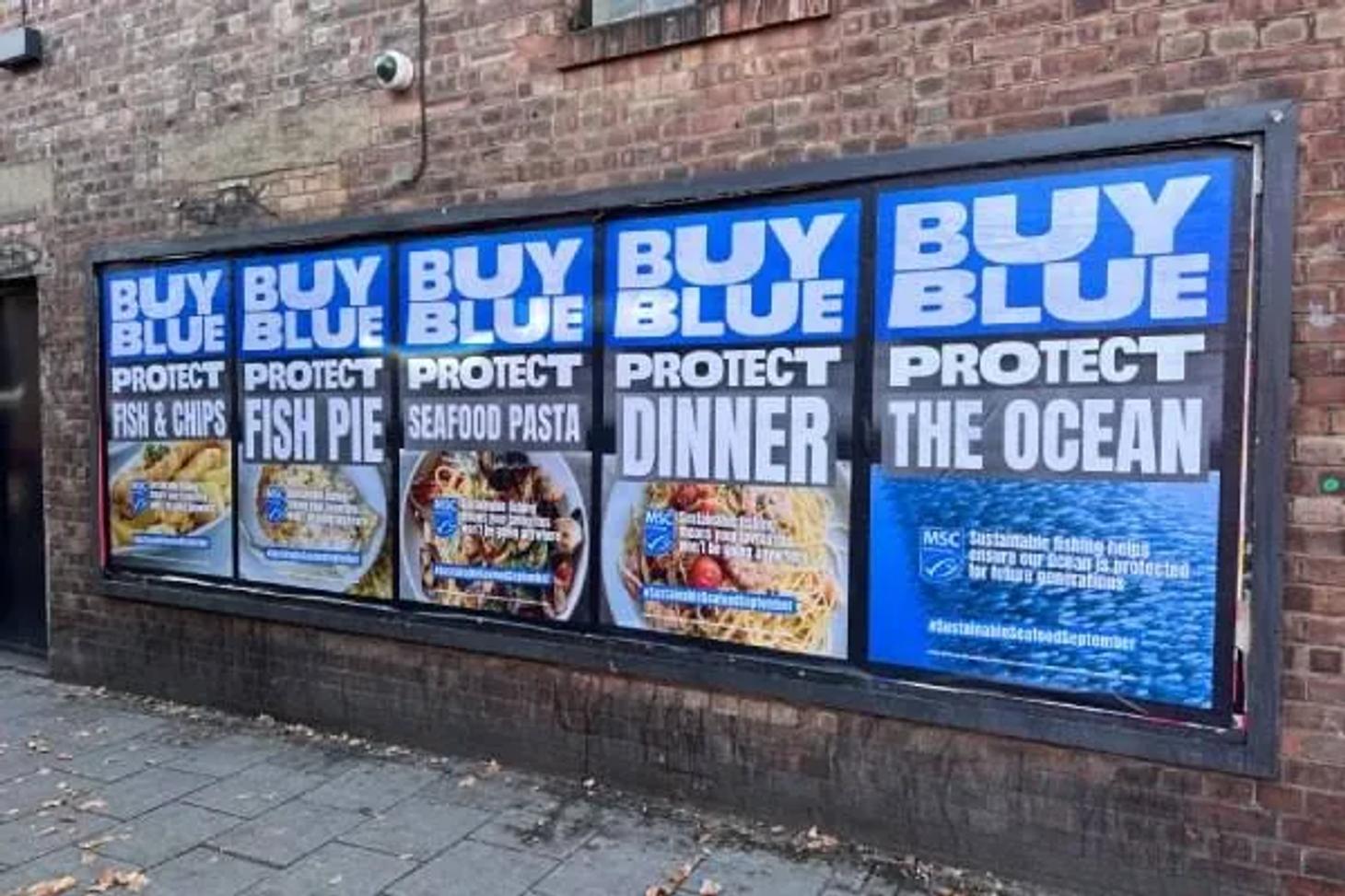
We have built campaigns on the same logic. For the Marine Stewardship Council, our Buy Blue, Protect Dinner work made the blue MSC ecolabel the whole idea, tying a sustainability certification to the dishes people actually eat. The label carried the campaign, because the label is the evidence.
Where to start your regenerative farming marketing campaign
Start with the audit, not the campaign. Before a single line of copy, list every green claim you intend to make and ask one question of each: what is the evidence, and is it published?
The claims that survive that test are your campaign. The ones that do not are a liability waiting to be noticed.
Build from purpose, because regenerative marketing only works when it sits on a foundation the business actually holds. Our guide to brand purpose sets out how that foundation is built before any claim is made on top of it.
Regenerative is the hardest green claim to make and the most rewarding to earn. Do the measuring, name the method, make the farmer the hero, and the campaign writes itself.
That is the work we do at Don't Panic: turning hard evidence into a story people actually buy into. If you are marketing a regenerative-farming proposition, see how we approach regenerative agriculture, and see how we can help you get the claims right before the campaign runs, not after a regulator picks them apart.