




Get your marketing mix right and the money follows. If you’re just focusing on performance-based ads, then you’re missing out on roughly 40% of the potential ROI pot, according to WARC’s Multiplier Effect research.
Yet most of the industry still treats the relationship between brand response and direct response marketing as a fight. Brand people guard the emotional territory. Direct response people guard the numbers, and neither side is finishing the job on its own.
In reality, nobody actually believes it's binary. They just don't have a framework for saying so out loud, which is what this piece is for.
The differences between brand response and direct response ads at a glance
- Direct response and brand response answer different questions, and mixing them up wastes budget on the wrong one.
- Objective: Brand response builds the emotional equity that makes the ask land harder, then closes with that ask; direct response converts a specific action now, a purchase, sign-up or vote.
- Time horizon: Brand response plays across months to years; direct response works in days to weeks, built to be switched off the moment it stops paying back.
- How success is measured: Brand response tracks brand health and cultural reach alongside a direct conversion metric; direct response tracks response rate, cost per acquisition and conversion to the individual click.
- Where it runs: Brand response uses TV, cinema, out-of-home, long-form social and earned media, paired with a clear response mechanic. Direct response uses paid search, direct mail, email, performance social and DRTV with a number on screen.
- Verdict: They aren't rivals fighting over the same line item. They're built to run in sequence, one creating the demand the other converts.
What’s the difference between direct response and brand response?
Direct response and brand response aren't synonyms, whatever most others want you to believe. Here's what each one is in practice, with a campaign behind each definition.
What is direct response advertising?
Direct response advertising asks for one thing, and asks for it now: a clear offer, a specific action, a result you can count by the end of the week.
Our Back Her to Back Herself work for Plan International UK is a clean example of our own work that we’re rather proud of.
The ask was simple: back girls, and do it now. No mood-setting, no slow build. One clear call to action, one route to act on it, and results you could count.
That's direct response at its most honest. One ask, tracked, done.
What is brand response advertising?
Brand response advertising builds an emotional case first, then asks for something concrete before the film ends.
Our Shelter Christmas campaigns are the model for this one. Five years running, we've made emotionally-led films built from the lived experience of families in temporary accommodation, each one closing on a direct ask for donations.
It isn't branding for its own sake and it isn't a bare appeal either. Shelter's own team has confirmed the donation figures have climbed every year the partnership has run.
For the fuller definition and the how-to, see our guide to brand response advertising.
Is brand response just brand marketing?
Search this term and you'll hit a contradiction sitting in plain view. Some sources use brand response as a straight synonym for brand marketing, nothing more than a fancier label for the same old work. Others, us included, use it to mean something specific.
The second definition is the correct one, and it isn't just us saying so. Marketing 360 defines brand response advertising as a hybrid that integrates the call-to-action goals of direct response with the storytelling tactics of brand marketing.
Plain brand marketing doesn't carry a built-in ask. It can, eventually, somewhere downstream. Brand response carries the ask by design, structural to the work from the first frame, not bolted on at the end.
That's the line. Everything on the wrong side of it is just brand marketing with good intentions, and good intentions don't show up on a donation form.
Brand response vs direct response: The four real differences
Once you've settled what each term means, the practical differences are what actually decide a budget meeting. Four things separate them, and each one changes what the work should look like.
1. Objective
- Brand response: carries two objectives at once and refuses to sacrifice either. It has to move someone emotionally, and it has to close with an ask.
- Direct response: exists to convert. Every choice in the brief, the media plan and the creative serves one outcome: getting someone to act, right now, in a way you can point to.
Drop the emotional half and you've made a direct response ad wearing a brand response label. Drop the ask and you've made a nice film that generates income. Holding both through the whole piece, instead of trading one off halfway through, is the actual discipline.
2. Time horizon
- Brand response: plays a longer game because it has to. Building enough emotional equity that an ask lands harder doesn't happen inside a single flight. It compounds across years of consistent creative territory, the way our Shelter work has built across five Christmases.
- Direct response: works in days and weeks. Launch it, measure it, kill it or scale it; the feedback loop is short enough that you can be wrong on a Monday and right by Friday.
That doesn't make brand response slow to convert. Each execution still closes with a direct ask on its own clock. What compounds slowly is the foundation underneath it, the thing making each year's ask land harder than the last.
3. How you measure success
- Brand response: has to hold two kinds of evidence at once. Brand tracking, share of search and cultural reach sit alongside a direct conversion metric like donations or sign-ups, and neither is optional.
- Direct response: is unambiguous. Response rate, cost per acquisition and conversion, all tracked to the individual channel and click. If a number can't be attributed, it doesn't count.
Measure only the emotional reach and you can't prove the ask worked. Measure only the conversion and you'll never know why it worked, or whether it keeps working. Most teams inherit a direct response dashboard and try to force brand response work through it; the dashboard needs both halves, or it's only measuring half the strategy.
4. Where each one runs
- Brand response: needs channels that can hold a story and a call to action in the same breath. TV, cinema, out-of-home, long-form social and earned media. Earned reach gives brand response the scale it needs without paying for every impression.
- Direct response: lives on channels built for tracked action. Paid search, email, performance social, direct mail, DRTV with a number on screen. The medium gets chosen because it can carry a measurable ask cleanly.
The channel choice isn't cosmetic. Put a direct response brief on a brand response channel and you get a hard sell nobody wants to watch. Put brand response ambitions on a direct response channel and the story gets cut before it lands.
What the data says about splitting the budget
The industry's 60:40 rule comes from the IPA's 2026 analysis of its own Awards case dataset. It still holds up as a starting point: just over 60% on brand building and a little under 40% on activation.
That ratio isn't fixed. Treat it as a sliding scale that moves with business maturity. Early-stage brands should lean closer to 70:30 toward performance while proving the model works; established brands should move back toward 60:40 in favour of brand as growth matures. The IPA's own dataset skews toward large, established B2C brands, so treat the ratio as a starting point for challengers, not a fixed law.
WARC's newer case data backs the direction of travel rather than one exact number. Its "Bring the Wave" repositioning for White Claw delivered a 21% market share gain by pairing emotional repositioning with performance discipline. FitFlop grew brand and sales on a limited UK budget by running both in the same plan.
Direct response captures the sale, brand marketing earns the choice. Brand response is the discipline of doing both in the same piece of work, which is exactly why it never sits neatly inside either half of a 60:40 split.
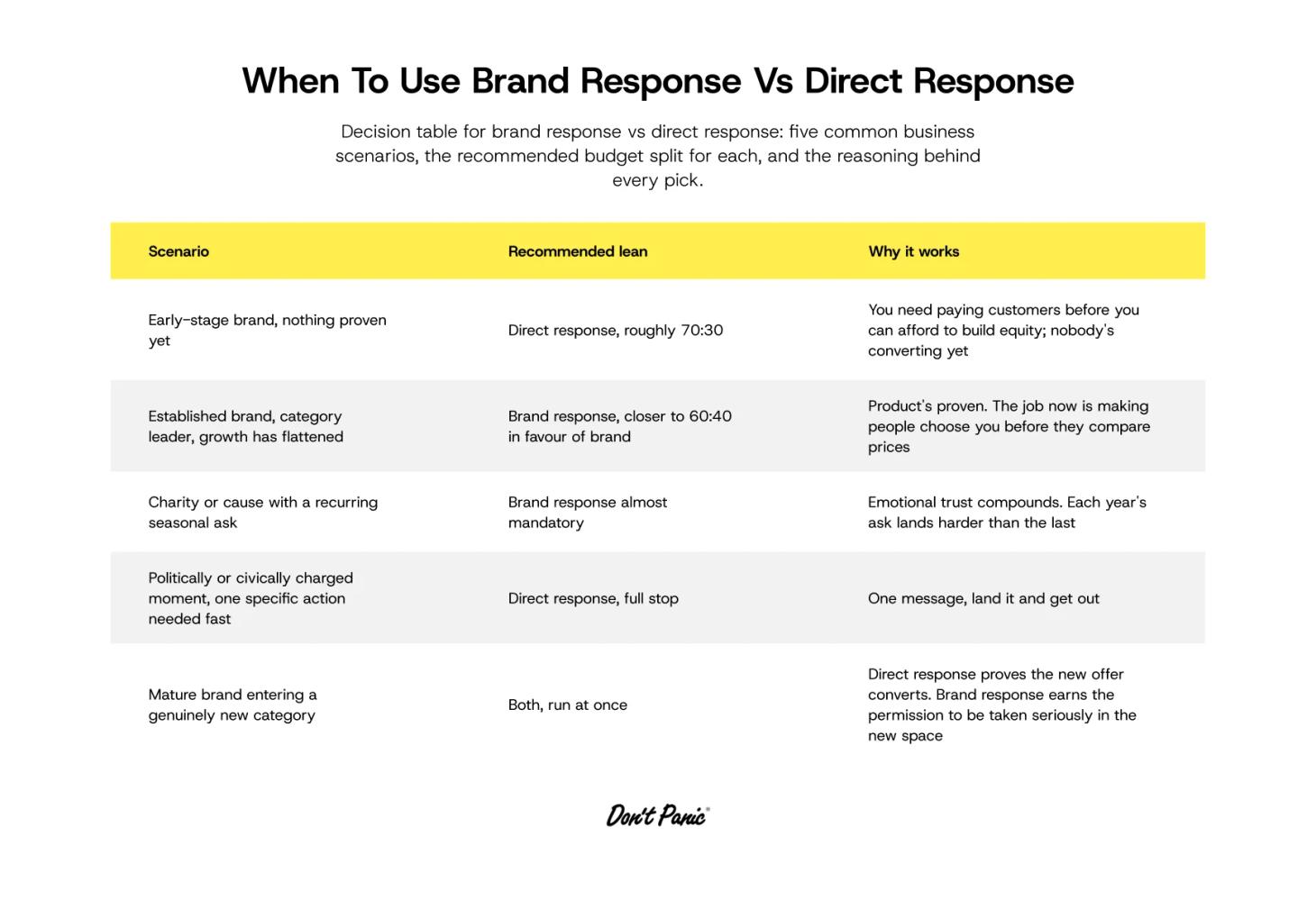
Brand response vs direct response: A working decision guide on which to use when
Early-stage brand, nothing proven yet: lean toward direct response, roughly 70:30. You need paying customers before you can afford to build equity if nobody's converting yet.
Established brand, category leader, growth has flattened: lean toward brand response, closer to 60:40 in favour of brand. You've already proven the product works; the job now is making people choose you before they compare prices.
Charity or cause with a recurring seasonal ask: brand response is close to mandatory. Our Shelter work only raises what it does because five years of emotional trust sit underneath every Christmas appeal.
Politically or civically charged moment, one specific action needed fast: direct response, full stop, the way Back Her to Back Herself was built to land one message and get out.
Mature brand entering a genuinely new category: run both at once rather than in sequence. Direct response proves the new offer converts while brand response earns the permission to be taken seriously in the new space. Neither works alone, and the case for creativity in advertising is really the case for building both halves properly.
Frequently asked questions about brand response vs direct response
Is brand response the same as brand awareness?
Brand response isn't the same thing as brand awareness. Brand awareness measures whether people recognise you and stops there. Brand response pairs that emotional territory with a direct, trackable ask, which is why plenty of brands have high awareness and zero brand response discipline.
Can a small brand skip brand-building and run direct response only?
Direct response alone works for a while, and plenty of early-stage brands should start there. But it gets more expensive as the easy audience gets exhausted. Skip emotional advertising for too long and every future conversion costs more, because nobody trusts you before they click.
Which should a new brand spend on first?
Direct response, weighted around 70:30. Prove the offer converts before investing in emotional equity nobody's ready to act on. Shift the ratio toward brand as retention data and repeat purchase patterns start to justify the longer play.
Does strong brand-building make direct response cheaper?
Direct response gets cheaper when brand equity is strong, and performance-only teams tend to underrate this. Brand equity lowers cost per acquisition because people already recognise and trust you before the ad asks for anything. That's the mechanism behind WARC's 40% performance-only penalty.
Stop treating it as a choice
Brand response and direct response were never supposed to be rivals. One creates the demand, the other captures it, and the businesses winning right now have stopped forcing a choice between them.
Expect this to matter more as time goes on. As attribution keeps fragmenting and the cheap, easy conversions dry up, the brands still growing will be the ones with enough emotional equity banked to make every direct ask work harder.
That's the work we do at Don't Panic: campaigns that carry both halves of the brief at once, brand and response, in the same piece of work. If your split's out of balance, earned media is usually where to start.