

Unpaid voices are five times more powerful than paid brand messaging when it comes to building trust, according to the 2026 Edelman Trust Barometer Special Report on brand growth. Nearly half of the most insular consumers say those unpaid voices have the biggest sway over whether they trust a brand at all.
Read that back and the case for purpose-driven work writes itself. The attention people give freely, because a piece of work moved them or said something worth passing on, carries a weight media spend can't replicate.
You can buy a slot. You can't buy someone repeating your idea in a group chat.
What follows is eight purpose-driven marketing campaigns that did exactly that. Four are ours, four are other agencies', and each is here for what it earned in culture rather than what it cost to run.
At a glance: the eight campaigns
Here are the eight, and why each one made the cut:
- Samaritans, "Wedding Day": Trust a single human moment and you don't need to raise your voice to land the point.
- UNICEF, "Choose Play Every Day": Reframe the everyday as the main event and people watch to the end.
- National Trust, "An Ode to Leaving": Turn a difficult ask into a feeling and a donation message becomes a promise.
- London Sport, "More Ball Games": Make the idea the media buy and 170 million in reach needs no paid support.
- MSC, "Buy Blue, Protect Dinner": Lead with the appetite, not the label, and a certification mark starts to matter.
- Trussell, "Football vs Hunger": Borrow the culture's own language and rivals will line up behind your message.
- Greenpeace International, "SLAPP Suit": Make an abstract threat physical and a legal issue becomes impossible to ignore.
- River Action, "March for Clean Water": Give people a visual they want to stand inside and the turnout becomes the message.
Purpose-driven marketing vs cause marketing
These two terms often get used interchangeably, but they shouldn't be. Cause marketing ties a brand to a specific issue, usually through a partnership or a donation mechanic: buy this, and a percentage goes to that. It's a transaction with a good outcome attached.
Purpose-driven marketing runs deeper. It starts from what a brand or organisation actually stands for, so the belief shapes the idea rather than bolting onto it. The cause can change campaign to campaign; the purpose doesn't.
The practical test is simple. Pull the donation line out of a cause campaign and it collapses; pull it out of purpose-driven work and the point still stands, because the point was never the mechanic.
If you want to understand the fundamentals, our piece on brand purpose covers the underlying definition.
8 purpose-driven campaigns that cut through
Eight campaigns, four made by us and four by other agencies, each picked for what it earned rather than what it spent. We've kept our own work honest and looked hard at everyone else's. Here's what travelled, and why.
Samaritans: "Wedding Day"
We made Wedding Day for the Samaritans 2025 Winter Appeal, with Max Fisher of Rogue directing. The film intercuts a father's suicidal thoughts with his daughter's wedding day, holding on the moments he might not have been there for.
What made it work: The film refuses to look away. Senior creative Zara Bennett wrote it from personal experience of loss to suicide, and it shows in how little the work reaches for effect, trusting the situation to carry the weight so the emotion feels earned.
The results: The hero film was backed by a special-build billboard in Hammersmith, drawn from the real story of Layla, a Samaritans caller who has since run a marathon and started planning her own wedding. Ambassador Gail Porter unveiled it on launch day, fronting a winter appeal to raise funds for people in crisis.
The lesson: The quiet approach carried further than volume ever could. One human moment, told without flinching, made the case that a single conversation can change a life.
UNICEF: "Choose Play Every Day"
Southpaw built Choose Play Every Day for UNICEF and International Day of Play 2025. The film takes ordinary phone footage of families mucking about, bedroom wrestling, backyard dance-offs, and scores it like televised sport, complete with the commentary you'd hear over a cup final.
What made it work: That single juxtaposition reframes small moments of play as the main event, exactly the behaviour the campaign wants parents to value. No lecture, no guilt, just a shift in how you see the thing you were half-ignoring.
The results: The campaign pulled 23 million YouTube views and 200 million social impressions, held a 90% completion rate, and took Gold in Social Purpose Use of Video at The Drum Awards. Completion that high means people stayed to the whistle.
The lesson: When the behaviour you're asking for feels like the reward rather than the homework, people watch to the end.
National Trust: "An Ode to Leaving"
An Ode to Leaving is ours, made with Rogue Films and director Simon Ratigan, released in January 2026. One woman narrates a lifetime of departures from the National Trust places that have always been there for her, shot across Lyme Park, Bodnant Garden, Penrhyn Castle and Porthdinllaen.
What made it work: Legacy giving is a hard brief, because asking people to think about gifts in wills sits too close to endings and most switch off. Acting ECD George McCallum's answer was to make leaving feel like love rather than loss, lingering on younger family members and half-remembered moments instead of the ask.
The results: The film poses one question that reframes the whole subject: what if you could leave for the last time knowing these places would be safe for the people you leave behind? It turns a fundraising message into something closer to a promise.
The lesson: Lead with the feeling and the ask stops sounding like an ask, even for a subject as heavy as legacy giving.
London Sport: "More Ball Games"
Saatchi & Saatchi made More Ball Games for London Sport in March 2025, and the idea is almost annoyingly simple. London has an estimated 7,000 "No Ball Games" signs; the campaign flips them, starting with one on the Mursell Estate in Lambeth turned into a working basketball hoop with the London Lions.
What made it work: A single sign becomes an argument. Each one, the charity says, deters around 80 young people from playing, so reclaiming it reads as both a stunt and a social-justice point about who gets space to move.
The results: There was no paid media behind any of it. The work generated over 170 million in reach on storytelling and community activation alone, was named Campaign of the Year, and pushed the issue as far as Westminster, with councils including Lambeth, Barnet and Haringey having since taken signs down.
The lesson: A strong enough symbol is its own distribution. With no budget behind it, the work still travelled nationally and moved the policy conversation.
MSC: "Buy Blue, Protect Dinner"
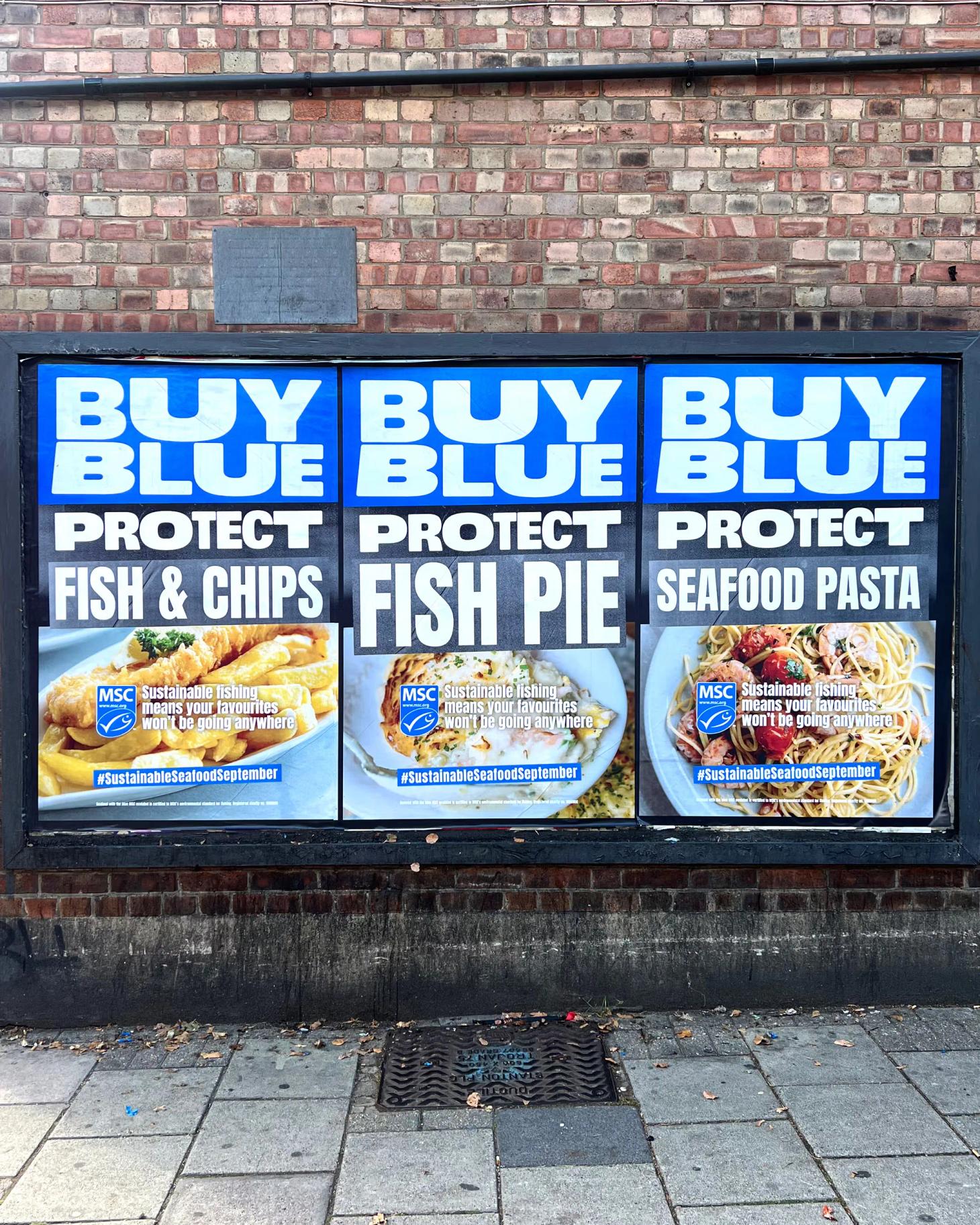
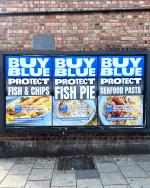
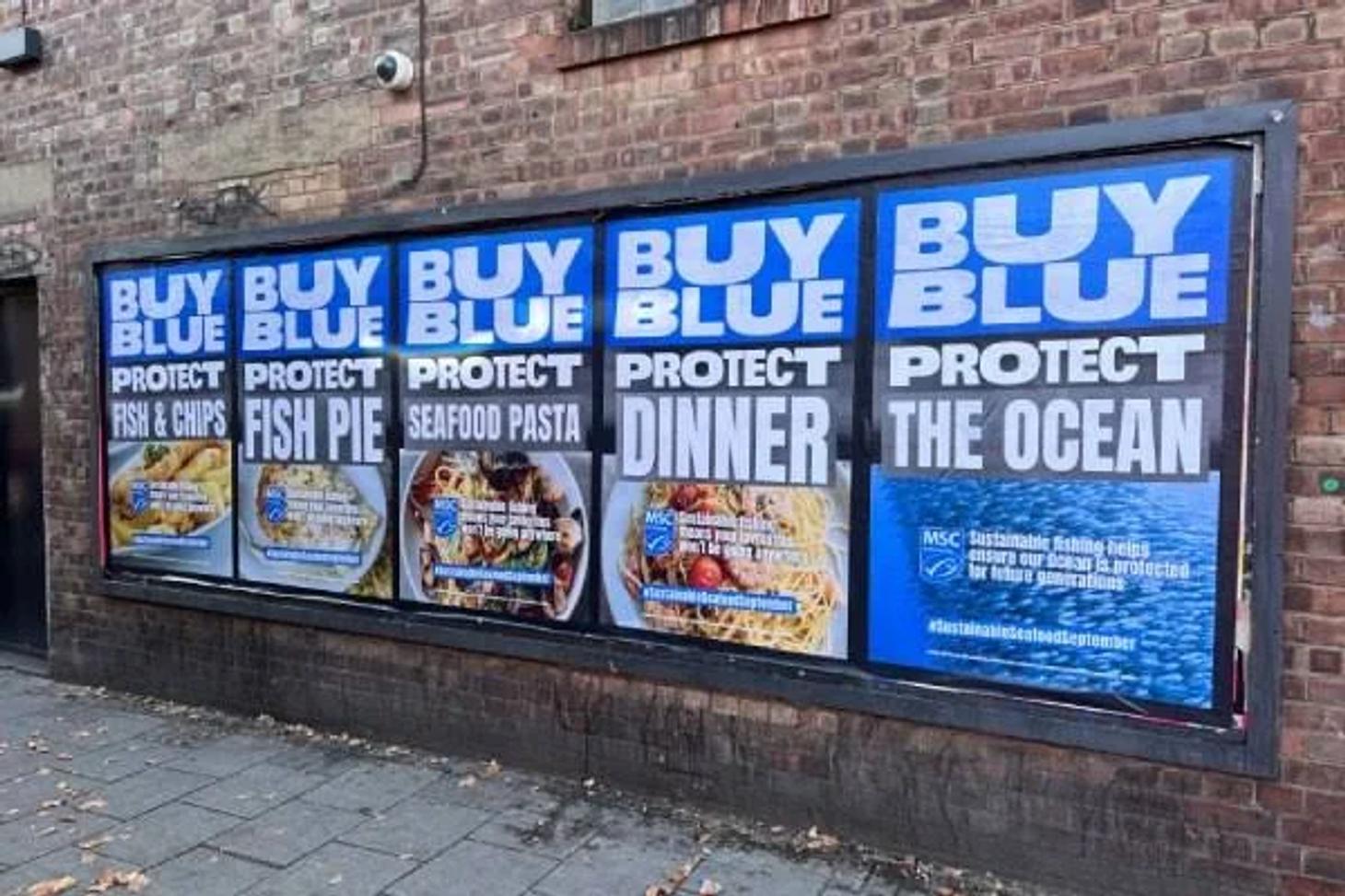
We made Buy Blue, Protect Dinner for the Marine Stewardship Council, launched for Sustainable Seafood September 2025 across the UK and Ireland. The campaign takes four of the nation's favourite seafood dishes and uses them to make one small blue ecolabel matter.
What made it work: Certification is a tough thing to make anyone care about. A logo on a pack is easy to walk past, and "sustainably sourced" barely registers any more. So we didn't lead with the label; we led with dinner.
The results: By starting from fish and chips and shellfish linguine rather than marine policy, the work met younger shoppers where their attention already is, on the plate. It performed well enough that MSC took the campaign coast-to-coast the following Easter, across four UK fishing towns.
The lesson: Put the ask underneath something people already want and it stops feeling like admin. Start from appetite, not the label, and a certification mark has a reason to matter.
Trussell: "Football vs Hunger"
The Romans made Football vs Hunger for Trussell in April 2025, working with football creator Bryan's Gunn. The film remixes football's favourite hyperbole, all that talk of teams being "hungry" for a win, and sets it against the real hunger that sends people to food banks.
What made it work: The craft is in the edit. Bryan's Gunn stitches together commentary, punditry and post-match interviews in his glitchy signature style, so familiar voices end up making an unfamiliar point about the sport's favourite word.
The results: Around the film sits "Trussell FC", a team fans are asked to sign for, backed by clubs including Liverpool, Everton, St Johnstone and Motherwell. The hero film alone drew 523,000 views, most of them unpaid on X.
The lesson: Speak in the culture's own language and it carries your message further than you could. Getting clubs that agree on nothing to agree on this is reach a media plan can't manufacture.
Greenpeace International, "SLAPP Suit"
SLAPP Suit is ours, produced by Partizan and directed by Martin Stirling, released globally on 28 May 2026. It stars Javier Bardem as a sinister Savile Row tailor stitching bespoke suits for fossil-fuel companies, and Yasmin Finney as a young protester measured up for one against her will.
What made it work: The film leans into horror rather than advocacy. Rolls of pinstripe carry the names of energy corporations; the stitching reads "GAG ORDER" and "CEASE AND DESIST"; the suit tightens until Finney's protester can barely move or speak, making an abstract legal threat feel physical.
The results: It dramatises Strategic Lawsuits Against Public Participation, the tactic Energy Transfer, Shell, Total and ENI have used to bury critics in legal costs, and it reunites us with the director of Most Shocking Second a Day. The film landed global coverage across trade and legal press on release.
The lesson: Give an invisible threat a body and it becomes impossible to ignore. The film closes on Finney breaking free, which is the point: these lawsuits are built to isolate, so the answer is collective and loud.
River Action, "March for Clean Water"
March for Clean Water was River Action's, announced with a film narrated by Sir Stephen Fry and held in central London on 3 November 2024. The film set the stage; the march made the picture.
What made it work: The creative call was to dress the protest itself. Marchers wore blue, so 15,000 people flowing from Albert Embankment to Parliament Square became a literal human river crossing the capital's polluted waterways. The image did the arguing.
The results: River Action led a coalition of more than 130 organisations representing 10.1 million supporters, from anglers and swimmers to farmers and citizen scientists. It stands as the largest march for water the UK has seen, and it landed a government response.
The lesson: Build the idea into the event and the crowd becomes the campaign; every person who turns up is also the media.
What makes a purpose campaign travel
Look across the eight and the same things keep surfacing, and none of them won on budget. Wedding Day and An Ode to Leaving trust a single human moment; More Ball Games and the March for Clean Water turn a sign or a crowd into the whole argument. The idea carried the cost, not the other way round.
Timing matters as much as craft. Choose Play Every Day rode International Day of Play; Football vs Hunger arrived mid-season when clubs and fans were already talking; SLAPP Suit dropped as an active legal fight made the subject live. Cultural relevance isn't decoration here, it's the reason the work moved when it did.
And every one takes a clear position without hectoring. The strongest purpose work states its stance and lets the audience arrive at the feeling on their own. It connects rather than shouts, which is exactly why people pass it on.
Purpose-driven campaign FAQs
What is a purpose-driven marketing strategy?
A purpose-driven marketing strategy builds campaigns around what an organisation genuinely stands for, so its beliefs shape the creative rather than sitting alongside it. It differs from a standard promotional strategy because the point survives without a hard sell attached. The work aims to earn attention and trust through cultural relevance, not paid reach alone.
How do you measure whether a purpose-driven campaign worked?
You measure a purpose-driven campaign on earned outcomes: press pickup, organic shares, completion rates, coalition sign-ups and, where it applies, behaviour or policy change. Reach and impressions matter, but the sharper signals are whether people passed the work on unprompted and whether anything shifted as a result. A campaign that changed a conversation beats one that only bought a big number.
Can for-profit brands do purpose marketing credibly?
For-profit brands can absolutely do purpose marketing credibly, as long as the purpose connects to what the business actually does and is backed by real action. Credibility comes from consistency over time, not a single campaign. The moment the message outruns the behaviour behind it, audiences notice, and the work does more harm than silence would have.
Make work that gets talked about
The campaigns here share one stubborn quality. They were built to be felt and repeated, not just seen, and that's what carried them past the reach any budget could buy. Purpose work fails when it lectures and travels when it connects, and the difference is usually the idea at the centre.
If you're weighing up purpose-driven work of your own, at Don't Panic we start from the same place every time: find the human truth, then make something people want to pass on. That thinking runs through all our purpose-led campaigns, and it's where any conversation about this kind of work should begin.