

Most ads are forgotten before the kettle boils. These nine weren't: one was named the best ad of the 20th century, one became the most-awarded campaign Cannes had ever seen, and one we made ourselves.
Old work wins the long game. Seven of the ten ads in Britain's all-time favourites, published in March 2026, first aired before 2010, according to a poll of over 1,000 UK adults for the British Arrows' 50th anniversary.
Each campaign below gets the same test: what it was, whether it worked, why, and what to steal.
Full disclosure: Save the Children's "Most Shocking Second a Day" is ours, and we've held it to the same standard of proof as the other eight.
The best marketing campaigns of all time at a glance
The nine, in date order, with the strongest proof for each:
- Smash "Martians" (1974): Campaign's industry pick for best ad of the 20th century.
- Cinzano's Rossiter and Collins ads (from 1978): Lifted the whole vermouth category, rivals included.
- The Guardian "Points of View" (1987): British Arrows Gold.
- California Milk Processor Board "Got Milk?" (1994): California's first milk sales rise in over a decade.
- Compare the Market "Compare the Meerkat" (2009): Twelve-month objectives hit in nine weeks.
- John Lewis "The Long Wait" (2011): Part of an IPA Effectiveness Grand Prix-winning run.
- Patagonia "Don't Buy This Jacket" (2011): Free publicity worth $40 million to $50 million, says its former CEO.
- Metro Trains Melbourne "Dumb Ways to Die" (2012): Five Grand Prix and 18 Gold Lions at Cannes.
- Save the Children "Most Shocking Second a Day" (2014): More than 80 million views and a Cannes Gold Cyber Lion, made with UNIT9.
How we chose these campaigns
Every campaign on this list had to pass at least one of three tests, and most of the nine pass two:
- A public vote: A place in a published poll of British viewers, such as Campaign's 2015 vote or YouGov's 2018 decade-by-decade survey.
- Top awards: A Cannes Lion, an IPA Effectiveness award, a British Arrow or a Clio, or a place on Campaign's lists of the best ads ever made.
- Evidence of effect: A sales, behaviour or publicity figure that someone published and put their name to.
Where the proof runs out, we say so. Loved isn't the same as effective.
This list is about what has stood the test of time. For newer work, see our pick of the best marketing campaigns right now.
Our round-up of ads people chose to watch covers more recent TV and online spots.
1970s and 1980s: when the ad break was the show
With three or four channels and no way to skip, Britain watched the ad break together, and the best ads became playground and pub catchphrases. These three are still quoted decades later, and each earned its place through public votes, industry awards or both.
Smash "Martians"
Boase Massimi Pollitt's Smash "Martians" first aired in 1974: a gang of tin robots from outer space, crying with laughter at Earthlings who peel, boil and mash their own potatoes. Smash, the instant mash now sold by Premier Foods, was the sensible alternative. John Webster prompted the idea, Chris Wilkins wrote it and Bob Brooks directed.
Did it work?
The industry thinks so. The same Campaign history says a panel of top industry figures chose it as the best ad of the 20th century, and that it sent sales "into the ionosphere".
The public agreed, putting it third with 11% in Campaign's 2015 poll of 1,002 UK adults.
It also came second among 1970s ads, with 26%, in YouGov's 2018 public vote. Nobody has published the sales figures behind Campaign's "ionosphere", so this verdict rests on fame, not tonnes of mash shifted.
Why it worked
The Martians turned the product's weakness inside out. Instant mash was the lazy option; the ad made peeling potatoes look primitive instead.
Steal this
If your product is the shortcut, don't apologise for it. Find someone who thinks the long way round is ridiculous, and let them laugh.
Cinzano "Airliner" and the Rossiter and Collins series
Collett Dickenson Pearce made ten Cinzano ads between 1978 and 1983, pairing Leonard Rossiter, Rigsby from Rising Damp, with Joan Collins. The joke barely changed: Rossiter tries far too hard to impress, and the Cinzano ends up all over Collins. "Airliner" (1979), written by Tony Brignull and directed by Hugh Hudson, took the routine on board a plane.
Did it work?
Saatchi & Saatchi's Kate Stanners picked it for Campaign's best ads in 50 years: "It's simple and it's silly, but it's gloriously self-aware." It came third among 1970s ads, with 12%, in YouGov's 2018 vote, rising to 20% among people aged 55 and over.
Here's the awkward bit. TGI data reported by AMSR shows a halo on vermouth drinking across the whole category, competitors included. Our very own writer Dan Collins still recalls his dad Ron, who created the campaign, was not best pleased. Or, In his words, “It pissed him right off.”
Why it worked
Rossiter's character was always trying too hard, so the brand never had to. Viewers were in on the joke.
Steal this
Let the brand laugh at itself. Then make sure nobody walks into the shop and asks for the other one.
The Guardian "Points of View"
Boase Massimi Pollitt's The Guardian "Points of View" shows a skinhead running at a businessman from three angles. From one he looks like he's fleeing; from another, like a mugger; only the full picture shows him pulling the man clear of falling bricks. Frank Budgen wrote it, John Webster art directed and Paul Weiland directed, and it took British Arrows Gold in 1987.
Did it work?
The History of Advertising Trust records that 1987 Gold. Nearly three decades later, it still came 14th, with 2%, in Campaign's 2015 public poll.
Campaign calls it "a powerful demonstration of the dangers of bias". No circulation figures are on record, so the case rests on craft and memory, not newspapers sold.
Why it worked
Being wrong about a stranger twice in one ad makes the argument for a newspaper that shows the whole picture.
Steal this
Don't tell people your brand is fair-minded. Let them catch themselves jumping to conclusions.
1990s and 2000s: lines the country repeated
Two campaigns from the 1990s and 2000s, two catchphrases that escaped the ad break. One turned an empty fridge into American shorthand; the other handed Britain a word it still uses to settle arguments, and both can show what happened to the numbers afterwards.
California Milk Processor Board "Got Milk?"
Goodby, Silverstein & Partners made Got Milk? for the California Milk Processor Board, a state programme funded since 1993 by a compulsory levy on California's fluid milk handlers. Instead of selling milk's goodness, it sold its absence. Its launch spot, "Aaron Burr", won Best in Show at the 1994 Clios: a history buff loses a radio quiz because peanut butter has glued his mouth shut.
Did it work?
In California, yes. The ANA Educational Foundation's case history records 1994 milk sales rising for the first time in over a decade, to 755 million gallons from 740 million.
Why it worked
Deprivation is a stronger truth than nutrition. Everyone knows milk is good for them; everyone also knows the misery of a dry mouthful and an empty carton.
Steal this
Sell the moment your product is missing. It's far more vivid than the moment it's there.
Compare the Market "Compare the Meerkat"
VCCP launched Compare the Meerkat in 2009, with Passion Pictures animating Aleksandr Orlov, a Russian aristocrat meerkat fed up with people landing on his site by mistake. The whole idea hangs on one dodgy pun, "market" and "meerkat", and a word Britain adopted: "Simples".
Did it work?
Fast. WARC reports that it hit its 12-month objectives in nine weeks, with quote volumes up 83% and cost per visit down 73%, in a case study that won Silver from the Account Planning Group.
Viewers loved it too: second, with 16%, in Campaign's 2015 public poll.
It also came second among 2000s ads, with 23%, in YouGov's 2018 vote.
Why it worked
Price comparison sites all offer the same thing, so a character became the difference. Nobody remembers a cheaper quote; everybody remembers the meerkat.
Steal this
In a category where everyone looks identical, stop competing on the spreadsheet. Give people someone to remember you by.
2010s: campaigns people chose to share
Online, nobody has to watch, so the best campaigns of the 2010s had to earn every view. These four did: people sought them out, passed them on and, in one case, sang along, and three can point to top awards or audited results.
John Lewis "The Long Wait"
Adam & Eve's John Lewis "The Long Wait" ran at Christmas 2011. A boy counts down the days in agony, and on Christmas morning runs past his own presents to give his parents theirs. A slowed-down cover of The Smiths' "Please, Please, Please, Let Me Get What I Want" does the rest.
Did it work?
The ad passed 1 million online views within days and reached 5.2 million on YouTube by 2014, according to the same Campaign history.
The bigger proof belongs to the run, not to one ad. John Lewis's advertising from Christmas 2009 onwards, the run that produced "The Long Wait", won the IPA Effectiveness Grand Prix in 2012.
Since 2009, those campaigns have generated £1.074bn in incremental sales and £261m in profit, as Research Live reported.
Why it worked
It flipped Christmas from getting to giving, which is exactly where a department store wants your head in December.
Steal this
Build a tradition, not an ad. One Christmas spot is a hit; a run of them becomes a date in the national diary.
Patagonia "Don't Buy This Jacket"
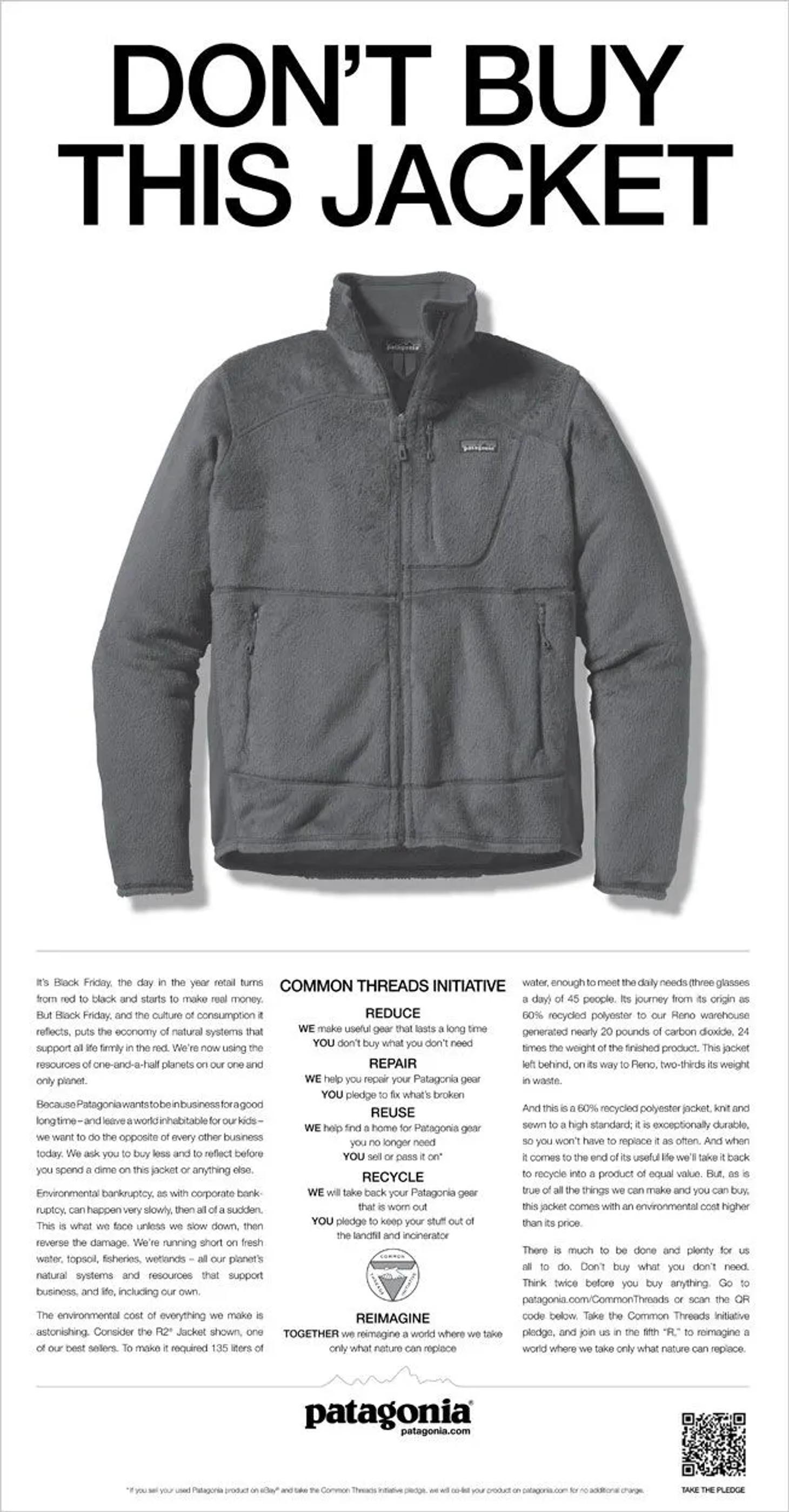
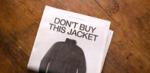
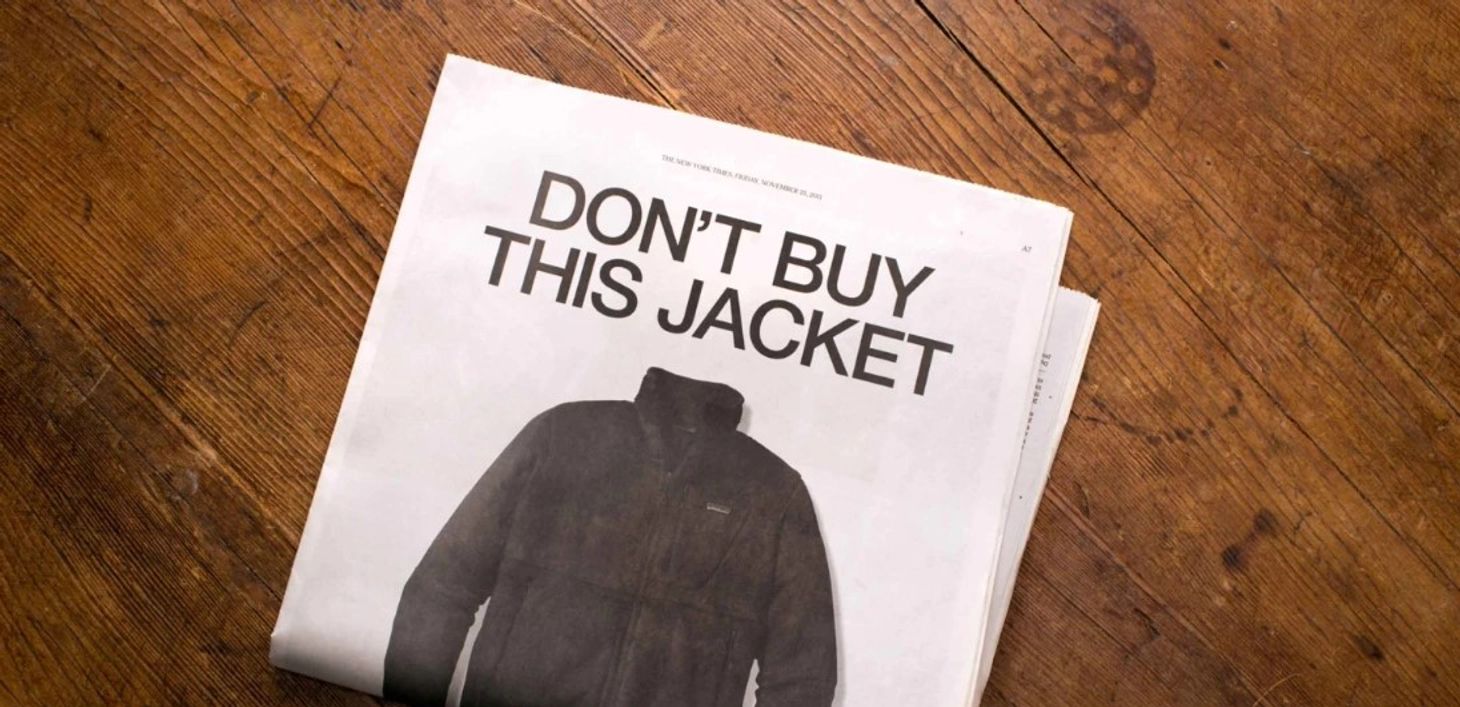
Patagonia ran Don't Buy This Jacket as a full-page ad in The New York Times on Black Friday 2011, from an idea by its own executive Rick Ridgeway. On the biggest shopping day of the American year, a clothing brand told shoppers not to buy its own jacket.
Did it work?
Spectacularly. Former CEO Casey Sheahan says the $57,000 ad bought $40 million to $50 million of free publicity, as quoted by journalist David Gelles.
Despite the anti-consumption messaging, sales spiked about 30% within months following the campaign. Patagonia's revenue reached $543 million in 2012—up from approximately $415 million the previous year.
Why it worked
The ad was believable because the business behaved like it. Patagonia became a certified B Corp the following month, in December 2011.
Since 2022, in the company's own words, "Earth is now our only shareholder."
Steal this
Say the uncomfortable thing about your own product, but only if the business can survive the scrutiny that follows. That's the difference between purpose-led campaigns and a stunt with a conscience bolted on.
Metro Trains Melbourne "Dumb Ways to Die"
McCann Melbourne's Dumb Ways to Die hit the internet in November 2012: a jaunty song by Tangerine Kitty, cute characters dying in idiotic ways, and a reveal that the dumbest ways of all involve trains.
Did it work?
It won five Grand Prix and 18 Gold Lions at Cannes in 2013, according to McCann's announcement, the most-awarded campaign in the festival's history at the time.
More importantly, it changed behaviour. The same Campaign report says Metro recorded near-misses falling from 13.29 to 9.17 year on year over November to January, a drop of roughly 30%. More than 44,000 people pledged not to do dumb things around trains in four months.
Why it worked
Rail safety messages usually wag a finger. This one hid the lecture inside a song people wanted to share, then delivered it in the last few seconds.
Steal this
Make the message the punchline, not the preamble. People pass on a joke; they rarely pass on a warning.
Save the Children "Most Shocking Second a Day"
We made Most Shocking Second a Day for Save the Children with production partner UNIT9, and it launched on YouTube on 5 March 2014. It follows a year in the life of a British girl, one second a day, as war arrives in her country and her ordinary life comes apart. The closing line: "Just because it isn't happening here, doesn't mean it isn't happening."
Did it work?
The original upload has passed 80 million views on Save the Children's YouTube channel.
It won a Gold Cyber Lion at Cannes in 2014, created by us with UNIT9. The 2016 sequel went on to win an ADC Gold Cube from The One Club in 2017.
Why it worked
It closed the distance. The war in Syria felt far away to a British audience, so the film brought it to a house and a family that looked like theirs.
Steal this
When people think a cause belongs to someone else, show them, with care, that it could be theirs. Our pick of the best charity marketing campaigns shows more causes earning attention that way.
FAQs
What is the best marketing campaign?
The best marketing campaign, in our view, is "Dumb Ways to Die". It won five Grand Prix and 18 Gold Lions at Cannes in 2013, and Metro reported a roughly 30% drop in near-misses in the three months after launch. Plenty of campaigns win the room or move the numbers, but very few do both, and fewer still for a rail safety message.
What was the most successful marketing campaign ever?
The most successful marketing campaign on audited numbers probably isn't on our list. Specsavers' IPA case study credits 30 years of its advertising with £1.1bn of incremental profit, earning IPA Effectiveness Gold in 2014. It's a body of work rather than one idea, which is the point: the biggest returns come from campaigns that keep going.
What the greats have in common
None of the nine bought their fame. Martians, meerkats, a skinhead with good intentions and a song about dying stupidly: each gave people something worth repeating. The audience did the distribution for free, for years, and that's the one kind of reach no media budget can buy outright.
That's earned media, the work we do at Don’t Panic, and the rules haven't changed since 1974. Find the tension your audience already feels, make it funny or impossible to ignore, then back it with a business that means it. If you want work people still quote in 2050, get in touch.