

Trust-based advertising is 41% more effective in driving business growth than the industry average, according to the IPA Effectiveness Databank, and far likelier to earn improved press coverage, 48% against a 37% average. You’d think that would be enough evidence for most teams to act on.
But, faced with evidence that the work people actually trust is the work that really pays off, most brands still meekly reach for the safe, committee-approved formula anyway: spend a bit more, tweak last year's flavour a scootch, fingers crossed nobody notices it's the same old crap.
The thing is, trust isn't a soft, warm-and-fuzzy metric. It's the raw multiplier on everything paid media tries to buy.
And it shows up in one place above all: whether the work earns attention or has to buy it. Trusted work picked up by the press for free and shared on its own merits. Everything else pays for every impression it gets.
Below: eight of the strongest pieces of work from the last 12 months and what makes each one earn its place. Four of them are ours. They're on the list because they pass the same test as everything else on it.
Best marketing campaign examples at a glance
- Shelter "Earworm" by Don't Panic London: a familiar tune can smuggle a statistic past the defences people put up against charity advertising.
- CALM "Missed Birthdays: Evelyn" by adam&eveDDB: name one real person and the audience feels what an aggregate figure can't make them feel.
- MSC "Buy Blue, Protect Dinner" by Don't Panic London: tie the cause to something personal and immediate, because nobody changes behaviour for an abstraction.
- Yorkshire Tea "The Biscuit Thief" by Lucky Generals: a platform that works should be stretched, not scrapped every time someone fancies a refresh.
- Medical Aid for Palestinians "Killed Saving Lives" by Don't Panic London: on the gravest subjects, documenting plainly beats performing emotion.
- Specsavers "The Original Blur Rival" by Specsavers Creative: earn a place inside a cultural moment and the audience does your distribution for you.
- Samaritans "Wedding Day" by Don't Panic London: show what support protects, not just the crisis it prevents, and the stakes land harder.
- Spotify Wrapped 2025 UK by St Marks Studios: a tiring global format gets its edge back the more local and specific you make it.
What makes a marketing campaign genuinely great?
Greatness isn't a media plan. It's a reaction: did people choose to pass the work around when nobody's holding a financial gun to their head? If not, your ad ain’t great, folks.
Paid reach ends the second the budget does. Earned reach keeps moving while your media buyers are asleep. The metric that matters isn't impressions; it's whether the work earned conversations in places where people don't use the word "synergy". Hard to measure, easy to feel.
The problem is, 99% of campaigns never clear that bar. Competently produced, sure. Accurately briefed, of course. But forgotten before the next Monday stand-up.
The eight below clear it in different ways. Some reframe a familiar statistic or hijack a cultural moment. Others say out loud what the rest of the industry is too polite, or too scared, to name.
The three questions behind every great campaign
Think of this as the Earned Media Test. Every entry on this list was judged against the same three questions:
- Would anyone share this if a brand wasn't paying them to? If the answer is no, it’s just an expensive ad. If yes, it’s a campaign.
- Does it earn a place in our culture? Hijacking a cultural moment without adding something genuine to it is creative theft, not innovation.
- Would the idea still work without the logo? The strongest work survives this test. The weakest collapses into a heap the second you remove the brand propping it up.
The 8 best marketing campaigns (and what they can show you)
Across very different budgets, the pattern holds: it's the idea that earns the attention, not the money behind it.
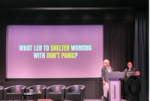
Shelter "Earworm" by Don't Panic London (2025)
The brief is one the charity sector knows intimately: cut through the blinding noise of Christmas with a homelessness story that doesn't immediately blur into all the other festive guilt-trips. Not exactly an easy night at the office.
The Earworm campaign is our fifth consecutive Christmas film for Shelter, directed by Michael Gracey of The Greatest Showman. A schoolboy hums "Total Eclipse of the Heart" throughout his entire day. He gets home and the reveal lands: the song isn’t a catchy tune, it’s the agonising hold music his mother’s been listening to for hours, trying to reach the housing service.
What made it work
Shelter reported 84,240 families in temporary accommodation when the ad ran. Most purpose-led work in this slot reaches straight for the harsh reality and forces you to look at it.
This one reached for something the audience already recognises: a song stuck in your head, a phone left on hold. The film builds a route in from a frustration everyone has felt, then closes the gap.
Results
Earworm earned coverage in The Drum and LBBOnline before its paid flight even peaked.
The lesson
A song the audience already knows can carry a statistic they’ve learned to ignore.
CALM "Missed Birthdays: Evelyn" (2025)
Most suicide-prevention work hides behind abstract stats. Fair enough, it's the safer choice for corporate stakeholders. It’s also exactly why most suicide-prevention work doesn't land.
You've seen the ads, but you can't remember which charity made them.
adam&eveDDB's Missed Birthdays: Evelyn for Campaign Against Living Miserably (CALM) did the exact opposite by telling the true story of Evelyn Gibson, who took her own life at 15. The family agreed to the creation of the campaign, directed by Sebastian Edwards through Academy Films and funded by the Iceland Foods Charitable Foundation. It ran across TV, VOD, cinema and social.
What made it work
It named a real person. Sounds painfully obvious, but it isn’t. The default in this category is the composite character, the safe actor, the gentle emotional remove.
CALM refused that safety. Once Evelyn has a name and a face, the audience can't unsee her.
Results
ITV News ran it as an actual news story rather than a marketing piece. That’s the win that matters. A current affairs desk taking your charity film and running it as the day’s headline is earned coverage no PR retainer can buy.
The work went on to win Gold at Cannes Lions 2025.
The lesson
A name does what a number never can. Specificity is the ultimate shortcut to genuine feeling.
MSC "Buy Blue, Protect Dinner" by Don't Panic London (2025)
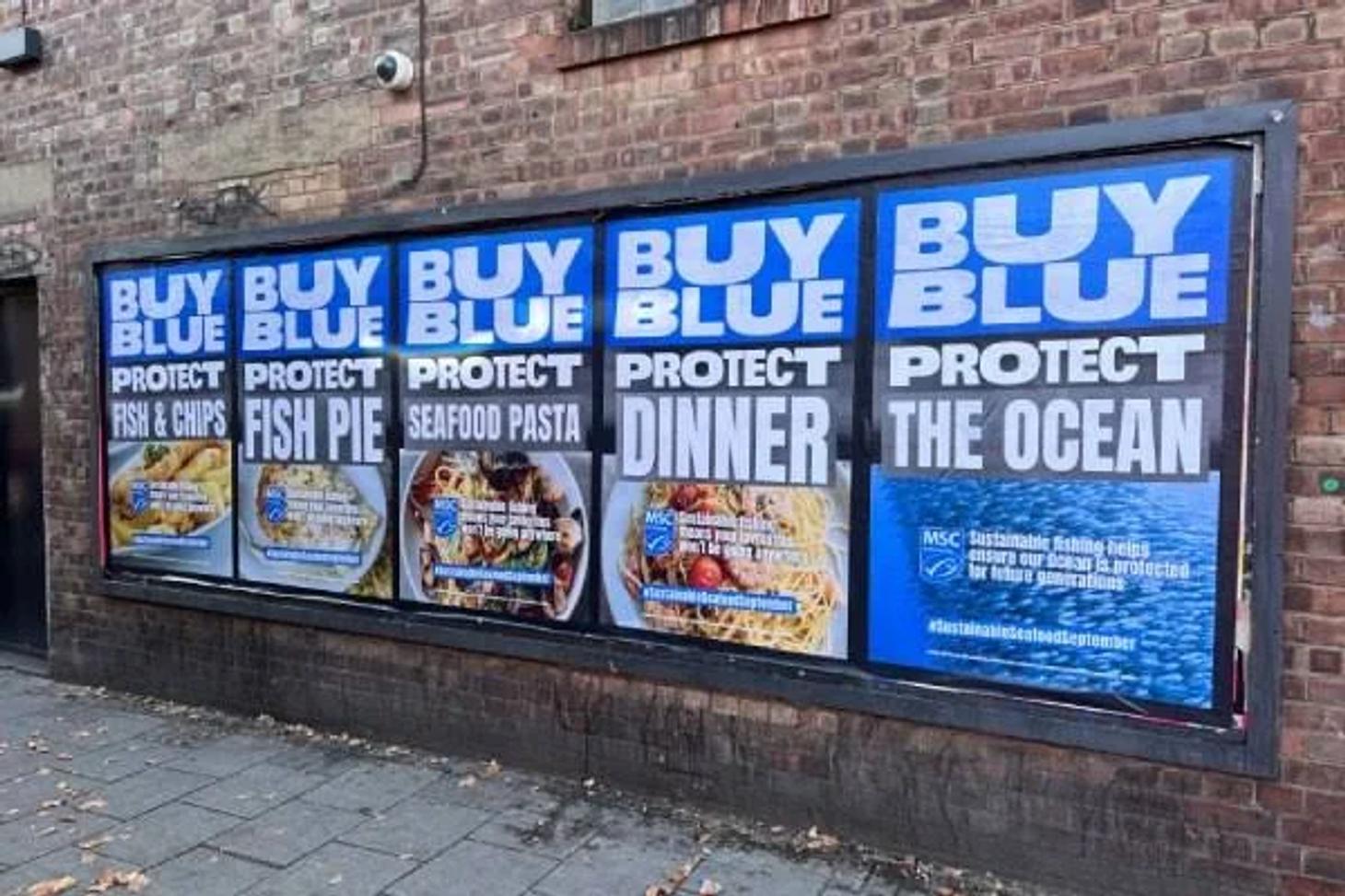
Sustainability briefs come with a terribly familiar trap: the high-horse moral framing. You know the drill:
save the planet, do your bit… try not to fall asleep before the end of the voiceover.
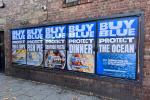
The Marine Stewardship Council (MSC) needed Sustainable Seafood September to land an actual, physical behavioural change in the supermarket aisle. Buy Blue, Protect Dinner refused the preachy moral framing entirely. We built it as an OOH and digital execution with one line of copy, zero lecturing, and a clean visual joke about dinner being at stake.
What made it work
People care more about what they’re eating tonight than ecosystem collapse in the abstract. Not exactly flattering to human nature, but it happens to be true. The campaign met consumers right at the point of purchase, appealing to their appetites rather than their guilt.
Results
Secured coverage in The Fishing Daily. More importantly, MSC extended the campaign to four UK coastal towns for Easter 2026.
An extension is the real KPI for OOH. Clients don’t renew work that didn’t move the needle.
The lesson
Make the stakes personal. Broad planetary framing will always lose to a plate of fish.
Yorkshire Tea "The Biscuit Thief" (2025)
Most FMCG platforms get bored with themselves around year three. The brief comes in, someone calls it ‘time for a refresh’ and promptly flushes a decade of built-up brand down the toilet in favour of something shiny for their own portfolio.
This is the third instalment of Yorkshire Tea’s ‘Where Everything’s Done Proper’ platform from Lucky Generals creative agency, launched in 2017. Directed by Traktor through Stink and starring Sarah Lancashire CBE, it’s a brilliant workplace whodunnit about the office biscuit tin. It ran across TV, cinema, BVOD and branded content on Netflix and Prime.
What made it work
Eight years in, Yorkshire Tea has built one of the most coherent, unshakeable brand worlds in UK FMCG. The casting, character work and sheer "Yorkshireness" all pay compounding interest. Most brands would have refreshed twice by now and lost the equity.
This one stretched it. There’s even a cheeky provocation underneath the joke: Sarah Lancashire is from Lancashire.
Results
Coverage in Marketing Beat. Earlier instalments of the platform have won a Grand Effie and a Gold IPA, two awards that prove commercial effect rather than just creative self-indulgence. Eight years in, the platform is still picking up trade praise for its longevity.
The lesson
Don’t refresh the platform every time a new brief lands. Stretch it. Casting upwards is significantly cheaper than starting over from scratch.
Medical Aid for Palestinians "Killed Saving Lives" by Don't Panic London (2025)
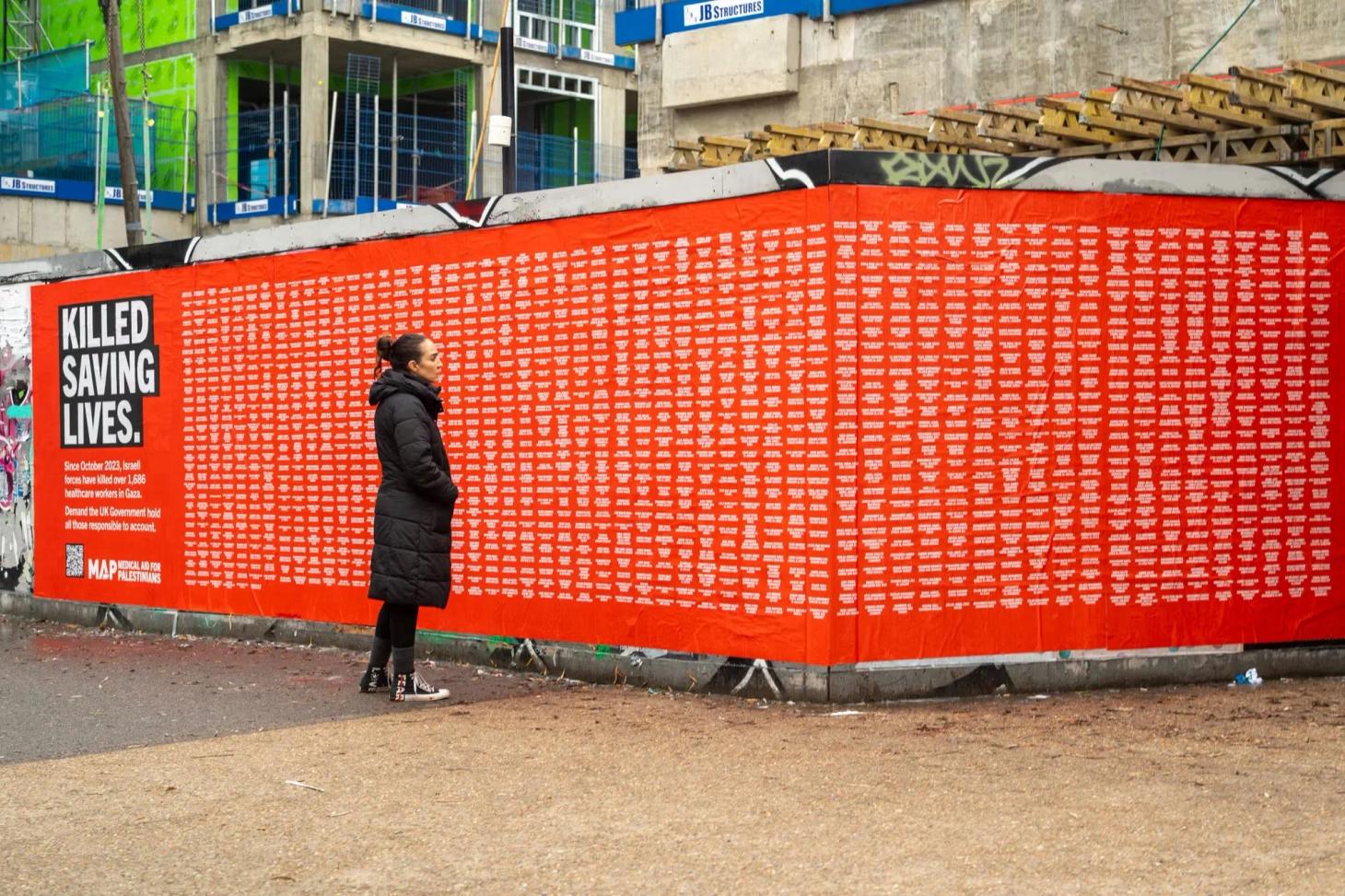
The default setting for charity advertising on a subject this serious is a solemn voiceover, a depressing statistic, a donation prompt and the obligatory celebrity narrator to make it feel official. Killed Saving Lives flatly refused all four.
MAP’s Killed Saving Lives was a public installation in London we created for MAP, a 10-metre-long memorial wall that named 1,686 Palestinian health workers killed in Gaza, photographed by Rowan Farrell. No music bed, no celebrity voiceover. Just a stark wall of names in a public space.
What made it work
It flat-out refused the conventions of charity advertising. No transactional ask in the moment of encounter. No donation prompt.
It simply made the scale of loss legible in a way a press release never could.
Results
Organic spread across social media, and image of the day in The Guardian. Visitors photographed the wall and posted it themselves, doing the heavy lifting of distribution that the campaign itself refused to ask for.
The lesson
Sometimes the most effective creative act is to stop performing and start documenting.
Specsavers "The Original Blur Rival" (2025)
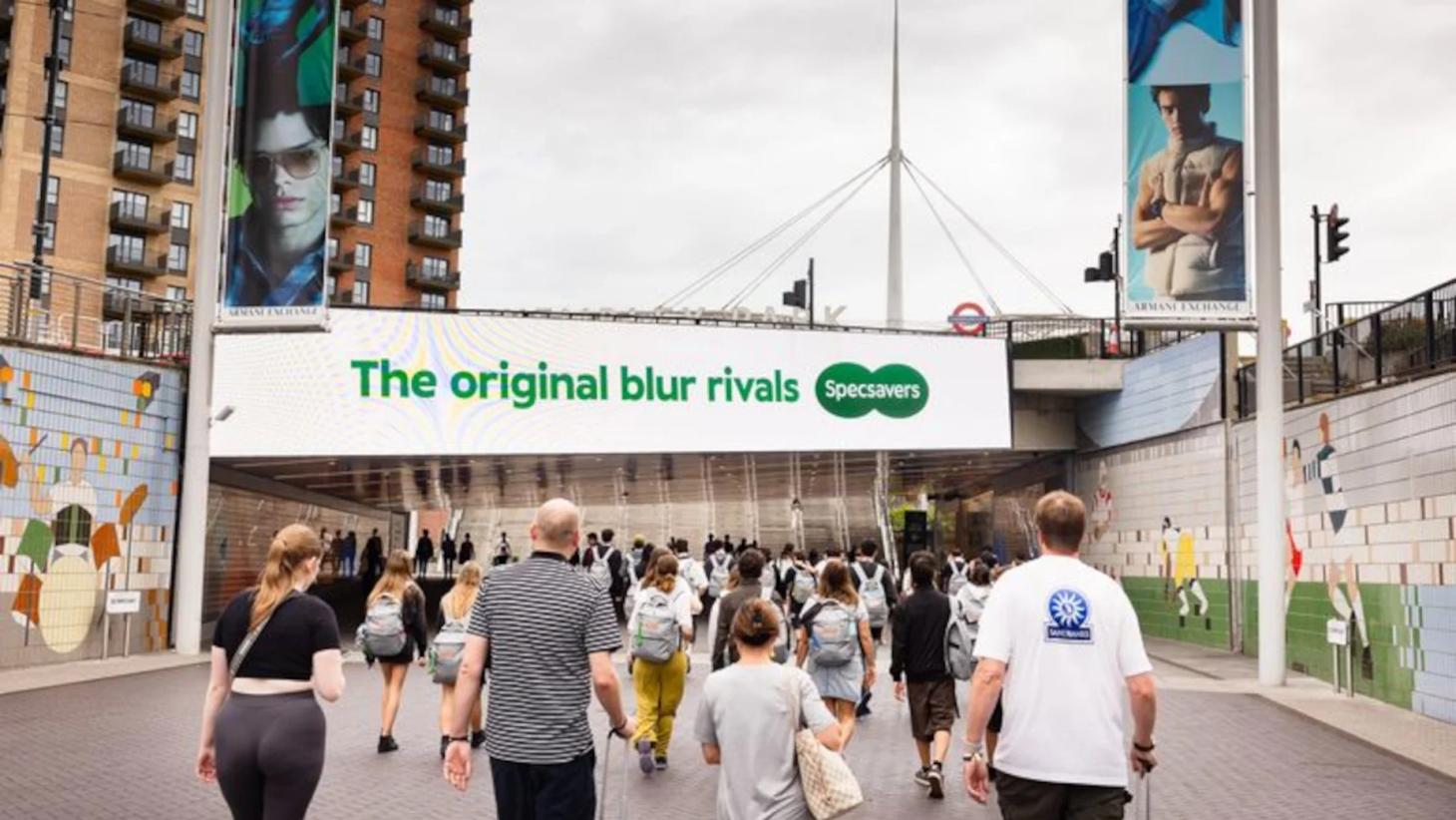
The "cultural hijack" is one of the most overclaimed, poorly executed moves in the marketing industry. Too often clumsy, late or both.
With The Original Blur Rival, Specsavers Creative timed a Wembley Park OOH activation perfectly to the Oasis reunion shows in 2025. Days earlier, under its audiology campaign The Whole Conversation, the brand ran a "hear-tch-hiking" stunt in Manchester that mapped the exact spots where fans could catch the concert audio without a ticket.
What made it work
Specsavers didn't make a boring ad about Oasis. It made an ad Oasis fans would actively want to post themselves. When the band itself reshared it, the campaign crossed the line from clever media placement to genuine cultural participation.
Results
Oasis reshared the work on Instagram, an act of endorsement no paid media budget can replicate. National press coverage followed in LBBOnline, Mediashotz and Mobile Marketing, cleanly attached to the main news cycle of the reunion.
The lesson
The best cultural campaigns aren’t actually about the moment, and they aren’t meta. They’re made with real care for the people living inside it.
Samaritans "Wedding Day" by Don't Panic London (2025)
The conventional approach to suicide prevention? Show the absolute rock-bottom crisis. And that’s exactly why most of it stops being noticed.
Wedding Day was our film built around one static data point: Samaritans answer a call for help every 10 seconds. Directed by Max Fisher through Rogue, it intercuts two timelines: Michael, a father in his car battling suicidal thoughts, and his daughter, preparing to walk down the aisle.
The wedding isn’t a nostalgic flashback. It is a future that the phone call protects.
What made it work
This film shows what a crisis takes away, rather than the aesthetic of the crisis itself. The audience feels the terrifying stakes through what’s at risk of being lost, rather than what’s about to happen.
That distinction is the entire creative engine, and most charity briefs on this subject never get anywhere near it. A supporting OOH build in Hammersmith carried the real story of Layla, who reached Samaritans years ago and is now planning her own wedding.
Results
Coverage in LBBOnline. The 10-second statistic has been part of Samaritans' communication for years, but this film turned it into a unit of time the audience could physically feel in their chest. The work went on to win Gold at the 2026 Smiley Charity Film Awards, listed under the campaign's appeal name, Help Bring Someone's Future Back.
It’s a different kind of metric and, let’s be honest, a far more effective one.
The lesson
Don’t just sell the cause. Sell the future that the cause makes possible.
Spotify Wrapped 2025 UK
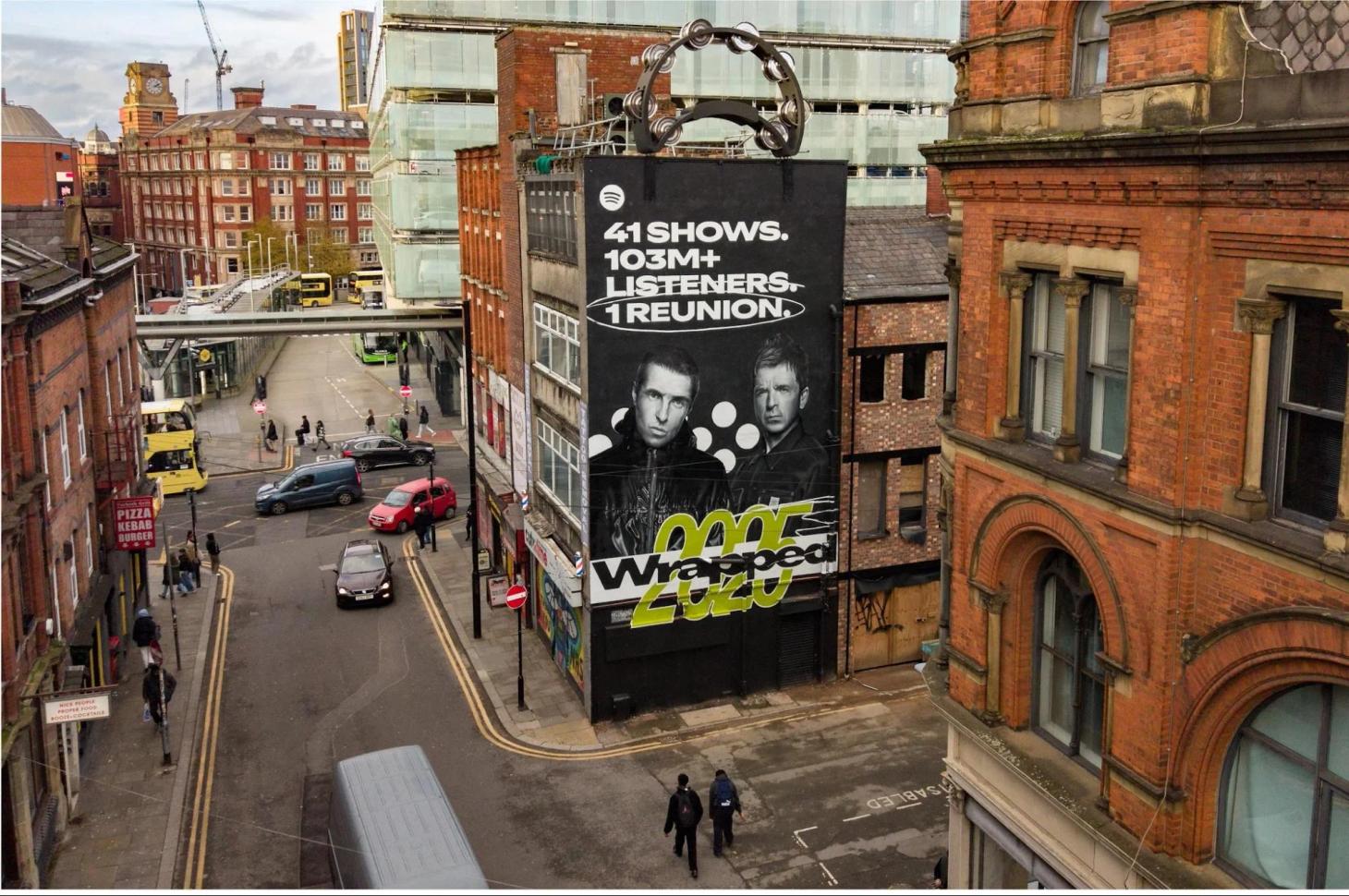
Wrapped has been using the same global format for five years. To be entirely fair, by 2025, it was almost starting to feel like a bit of a chore. Branding familiarity has a strict half-life.
Spotify Wrapped 2025 was the first standalone UK Wrapped film, produced by Curly Media, while St Marks Studios handled the physical OOH installations. It featured an Oasis mural in Manchester, a Central Cee bling billboard in Shepherd's Bush, and a PinkPantheress phone box wrap by Tower Bridge. It was local, hyper-specific, and unmistakably British.
What made it work
Spotify deliberately split the UK out and built a campaign deeply rooted in place. Manchester got Oasis; London got Central Cee and PinkPantheress. Each city was treated as the active audience, not just a scenic backdrop.
The brand could easily have cut a lazy global film for fourteen markets like every other year. The harder, smarter move was the one it actually made.
Results
Coverage in The Drum, Pause Magazine and Creative Review. The Manchester Oasis mural and the PinkPantheress phone box became standalone viral stories of their own, photographed and shared as Wrapped-adjacent content by audiences the brand never even directly addressed.
The lesson
Global formats eventually decay. Hyper-local detail gives them back their sharp edges.
What the best campaigns have in common
The pattern is starkly clear once you line them up, and it has absolutely nothing to do with bank accounts. Even the cheapest work on the list, the MAP installation, generated international news coverage that a six-figure paid media spend cannot reliably guarantee. The most consistent, Yorkshire Tea, kept paying off simply because someone in the room resisted the urge to blow up the strategy and start over.
Budget isn’t the variable that matters. Conviction is.
Specificity is the other shared trait. Evelyn Gibson, not a faceless, rounded-off statistic. The Oasis reunion, not generic "music culture"
A wedding day, not an abstract psychological crisis. Specific work travels because audiences recognise themselves in it, or recognise something true outside it.
Generic work, however beautifully polished, asks the consumer to do the heavy imaginative labour that the brand should have done for them. And that’s exactly where most advertising falls flat on its face.
Finally, every campaign on this list earned serious coverage before its paid media flight even peaked. Trade press, organic social, national news.
The sequence matters infinitely more than the raw volume. Earned attention arriving first means your paid media budget is amplifying a conversation that is already moving. Paid attention arriving first means loudly announcing yourself into a cold, dead silence and hoping someone joins in.
The second option is significantly more expensive and vastly harder to defend at the next quarterly review.
That sequence is what separates the work worth studying from the creative wallpaper that fills the rest of the calendar year.
FAQs
What makes a marketing campaign successful?
A successful marketing campaign in 2026 clears three bars, not one vanity metric: it shifts a behavioural outcome you can measure, it earns media coverage the brand didn't pay for, and it strengthens the brand's position for whatever comes next. Hitting all three is rare. Hitting one and claiming all three is what most agency case studies do.
What do recent marketing campaigns worth studying have in common?
Recent marketing campaigns worth studying share one refusal: they reject the lazy visual shorthand of their category. Charity work that doesn't show suffering, sustainability work that doesn't show melting icebergs. Category convention feels safe to a middle manager and forgettable to the public. The strongest work broke its own category's defaults.
How do you measure a campaign's cultural impact?
A campaign's cultural impact is measured away from your paid channels, not inside the media dashboard. Look for press pickup beyond the marketing echo chamber, organic share velocity in the first 72 hours, and references in unrelated contexts weeks later. Most corporate frameworks miss all three, which is why annual reviews congratulate the wrong work.
What is the difference between a great campaign and a viral one?
The difference between a great campaign and a viral one is direction versus volume. A viral video moves a lot of people somewhere, often nowhere useful. A great campaign moves the right people toward a specific brand or a permanent behaviour change that compounds over time. Most viral campaigns can't say the same.
The best ideas earn their place
What work will actually matter in 2026 won't be the work with the biggest, heaviest media plans. It will be the work brave enough to pick something specific, a person, a moment, a sharp cultural truth, and then trust the audience to do the rest.
So before you sign off on the next big spend, run the brief through the Earned Media Test in this piece: would anyone share it if you weren't paying them to, does it earn its place in the culture, and would the idea survive without the logo? If a brief can't answer all three, more budget won't save it, it will just buy a bigger silence.
That's the bet we make at Don't Panic: earn the attention first, then let paid media amplify a conversation that's already moving. It's the thinking behind our earned media work, and it's the same test we'd apply to yours. If you're briefing creative this year and you want the idea to travel rather than just air, get in touch.