




Most charities receive legacies. Few run legacy programmes.
One is crossing their fingers and hoping for the best. The other is building a pipeline that protects their future - with ownership, process, stewardship and reporting that still works when someone’s on annual leave.
UK legacy income hit £4.5 billion in 2024, up 9% year on year. The charities capturing that growth aren’t “doing more comms”. They’re running the basics properly, consistently, and safely.
This guide focuses on the operational side: how to set up a legacy fundraising programme that actually runs and builds lasting support.

What is Legacy Fundraising?
Legacy fundraising (also called planned giving or bequest fundraising) is how charities build long-term income through gifts in wills. It isn’t a campaign you run once. It’s a constantly-running programme with a defined workflow, a stewardship system, and internal guardrails that protect supporters and the organisation.
What follows is a practical setup sequence: the steps, processes, and measurements you need before gifts arrive. For details on how to spread the word once you’re set up, check out our legacy marketing guide.
What Do You Need in Place Before You Build a Legacy Fundraising Programme?
If you only take away one thing today, it’s this: don’t scale your legacy fundraising activity before you’ve built the infrastructure to support it.
A minimum viable legacy fundraising programme needs:
- one named owner
- a simple workflow in your CRM (enquiry → pledge → disclosure)
- service standards (so supporters aren’t left waiting)
- stewardship you can deliver without heroics
- basic compliance controls (so no one has to improvise)
If those aren’t in place, you don’t have a programme. You have good intentions and a LOT of risk.
Legacy Fundraising Best Practice in the UK: The Rules You Can’t Wing
The Code of Fundraising Practice came into force on 1 November 2025. It sets the compliance baseline. Everything you build needs to work within it.
Legacy fundraising is high-trust. It’s also high-risk if you’re casual about boundaries. Best practice here isn’t what feels impeccably polite. It’s what keeps your supporters safe and keeps your programme defensible.
How to Avoid Undue Influence (and Still Be Helpful)
Your job is to inform and support not steer decisions. That means you don’t suggest gift amounts, you don’t imply expectation, and you don’t apply pressure (even softly, even indirectly). Helpful is fine. Persuasive is not.
A simple internal rule helps: if you’d feel uncomfortable reading it back in a complaint, don’t say it.
How to Handle Vulnerable Circumstances Without Improvising
You need an escalation route that’s clear enough for a new starter to follow. If someone discloses bereavement, serious illness, distress, or anything that signals vulnerability, the worst thing you can do is “keep going” with the script because you don’t want to get it wrong.
You won’t get it perfect. But you can get it safe: pause, escalate, document, adjust contact.
Consent, Privacy and Record Keeping: What You Must Log
Legacy programmes fall apart when knowledge lives in someone’s inbox. Make it a standard: consent, preferences, and relevant conversation notes have to be logged consistently in one place.
If someone asks “did we have permission to contact them like this?”, you need the answer fast, not after a panicked search across various emails and spreadsheets.
Complaints and Escalation: Make the Route Obvious
A visible complaints route isn’t just about risk management. It’s good service. Document complaints, what you did, and what changed as a result. Your processes will improve quicker if you treat complaints as process signals, not reputational emergencies.
What Does a High-Performing Legacy Fundraising Programme Look Like?
A high-performing legacy programme isn’t “better materials”. It’s a system: a clear proposition, a defined pipeline, consistent stewardship, safe handling, and reporting that drives decisions.
You can usually tell where a charity sits in about five minutes:
- Ad hoc: you receive gifts in wills, but there’s no owner, no workflow, and no legacy pipeline tracking you trust.
- Repeatable: you’ve got a defined journey (enquiry → intention → disclosure), someone owns it, and the data is good enough to manage.
- Scaled: stewardship tiers run consistently, reporting is reliable, and legacy fundraising governance is routine rather than reactive.
The steps below are how you move from ad hoc to scaled.
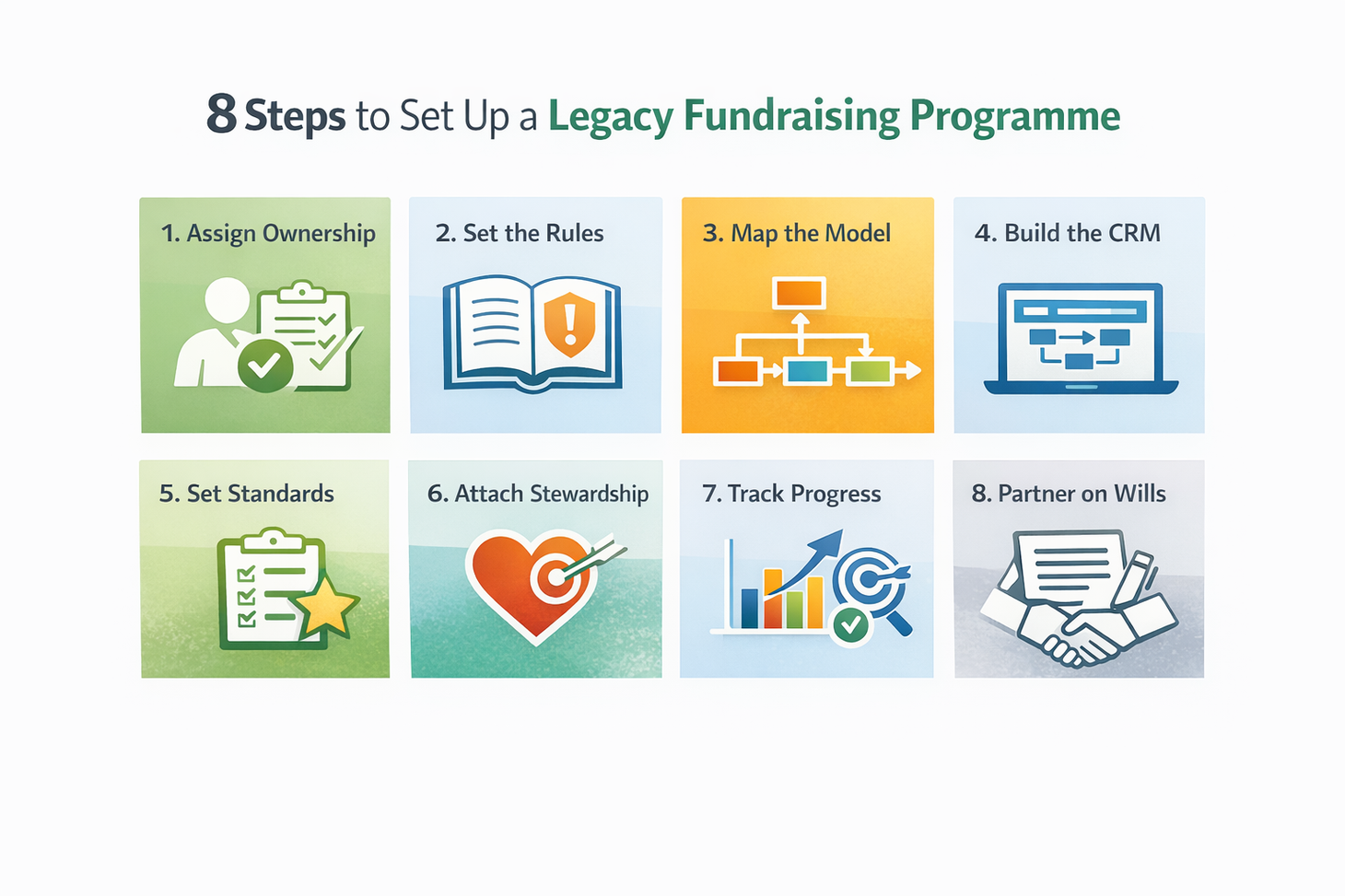
How to Set Up a Legacy Fundraising Programme that Actually Works in 8 Steps
Complete each step of this build sequence and you’ll end up with an owned, safe, measurable and repeatable legacy programme - long before any gifts arrive.
Step 1: Assign Ownership and Define Year-One Success
Name a single owner. They’re not there to do everything, mind. It’s their job to ensure delivery doesn’t drift.
Next, define what success means in year one. If your definition relies on legacy income landing quickly, you’ll either panic when it doesn’t or just perform for the dashboard.
A smarter definition is operational: a pipeline you can see, service standards you can keep, stewardship you can deliver, and reporting leadership trusts.
Deliverables:
- Named programme owner and clear internal contact route
- Short scope statement (what’s included/not included)
- Year-one success definition based on pipeline and service standards
Step 2: Set the Rules So Nobody Has to Improvise
Before you scale anything, write a simple internal playbook. Aim for a practical guide people will actually use instead of a War and Peace-esque policy novel.
Include boundaries on influence, what good looks like in sensitive conversations, how consent and preferences are logged, and where complaints go.
This is also where you remove ambiguity. You don’t want staff doing what “feels right in the moment” under pressure. You need them to follow a safe, agreed approach.
Deliverables:
- Set guidance on “what we can say/must not say”
- Clear escalation triggers for sensitive circumstances
- Consistent logging standard for consent/preferences and notes
Step 3: Build the Operating Model
Legacy fundraising programmes can easily stall when people share responsibilities. Make ownership of roles explicit across the core activities: enquiry handling, stewardship delivery, CRM/data, partnerships (if you have them), and reporting.
This need not be byzantine in its complexity. It just has to be clear enough that nothing falls through the cracks.
Deliverables:
- Clear owners for enquiry handling, stewardship, CRM/data and reporting
- Defined handover processes (so supporters aren’t bounced around between people)
Step 4: Build the Workflow in Your CRM
If it’s not structured in your CRM, it doesn’t exist. Your workflow stages should be plain English, consistent across the organisation, and designed for reporting.
Keep it simple:
- Legacy enquiry: someone requests information or expresses interest
- Pledge/Intention (legacy pledge notifications): someone tells you they’ve included you (or plan to)
- Legacy gift disclosure: someone shares specifics (solicitor details, gift type, documents, etc.)
For each stage, define what done means and what has to be logged. If gift type is shared, record it accurately (e.g. residuary gift or pecuniary legacy) but don’t infer or estimate.
Treat this as legacy pipeline tracking: you’re building a system that lets you see volume, stage movement and drop-off points without guesswork.
Be ruthless about your CRM fields: you’re choosing them now so you can report the leading indicators in Step 7 without sweaty manual workarounds.
Deliverables:
- Stage definitions everyone can repeat without improvising
- Minimum CRM fields agreed (source, last contact, next action, preferences/consent, notes)
- A clear escalation flag so sensitive issues don’t get buried
Step 5: Set Service Standards that Make the Programme Feel Professional
Consistency is your differentiator here. Set a small number of service standards you can keep, then track them as part of your legacy fundraising KPIs (alongside your pipeline measures in Step 7).
Start with the moments that cause most frustration or risk: legacy enquiry acknowledgement, sending information, logging legacy donation intentions and disclosures, actioning changes in the donor’s wishes, and handling escalations.
Deliverables:
- Documented response standards for key touchpoints
- A simple monthly check-in that shows where you’re succeeding and where you’re slipping (and why)
Step 6: Attach Stewardship to the Stages
This is where legacy fundraising programmes usually wobble: stewardship starts strong, then everyone gets busy, and it quietly disappears like Homer Simpson into a hedge. Bad news for legacy donor retention.
Fix that by making stewardship part of the workflow. It can’t afford to be a separate “nice to have”.
A simple tier model that works:
- Enquirers get a light, reliable cadence
- Pledgers get more personal acknowledgement and planned touchpoints
- Disclosers get higher-care, VIP-standard stewardship (more personal, not louder)
Keep it preference-led. This is charitable legacy stewardship done properly: consistent, preference-led, and sustainable for your team.
Deliverables:
- Three stewardship tiers aligned to CRM stages
- A cadence per tier you can actually deliver
- A process for preference changes that isn’t ad hoc
Step 7: Measure Progress Before Gifts Arrive
Legacy income is a lagging indicator. If you wait for gifts to judge performance, you’ll be managing blind in the meantime. Best avoided.
Track leading indicators (your legacy fundraising KPIs). This is what’ll tell you if your programme is functioning: enquiry volume, response times, stage movement, drop-off points, and whether stewardship is delivered as planned. Keep measurement useful - the point is to make decisions, not produce pretty slides.
Deliverables:
- Small monthly dashboard (pipeline + service standards + stewardship delivery)
- Two or three “if this happens, we do that” triggers (e.g., response times slip → fix handovers)
Step 8: Add Partnerships Only When the Basics Are Stable
Will-writing and referral partnerships can accelerate enquiries, yes. They also ramp up the risks if your fundamentals are shaky. Only add partnerships when you’re sure you can govern them properly and track outcomes end-to-end.
Partnership success relies on transparency, supporter safety, and measurable outcomes you can stand behind.
Mini-checklist: What Must be Transparent in Any Will-Writing Partnership
Before you launch, be crystal clear on:
- Advice boundaries: what the partner can advise on, what your charity cannot advise on, and when supporters should seek independent legal advice.
- How referrals work: what counts as a referral, what data is shared, and how supporters opt in/out of the referral journey.
- Costs and incentives: whether the will is free, subsidised, or conditional — and whether any referral fees or commercial relationships exist.
- What gets tracked: referral source → appointment → will completed → charitable bequest included (where known) → onward stewardship.
- Complaints route: who handles complaints about the service, how they escalate, and how the charity is notified and records outcomes.
You’re ready if you have:
- Clear supporter-facing transparency wording
- CRM tracking from referral source to outcome
- Defined oversight rhythm (reviews + complaints route)
What are the 3 Most Common Board Objections (and How Do You Answer Them)?
Objection 1: “We won’t see ROI for years”
They’re right! But that’s not the full picture, and is exactly why you need those leading indicators. You can show your progress in months through tracking pipeline volume, stage movement, response times, and stewardship delivery. A legacy programme creates long-term value through short-term operational discipline.
Objection 2: “What if we do something inappropriate?”
That risk doesn’t disappear by doing nothing, but it does increase when you do legacy work without guardrails. The answer is your playbook: boundaries on influence, escalation triggers, consent logging, and a visible complaints route. Luckily, it’ll all be built into the programme if you’ve taken the time to set it up right.
Objection 3: “We already mention legacies in appeals”
Mentioning legacies is not a programme. A programme has ownership, workflow stages, CRM tracking, service standards, stewardship tiers, and reporting. Without those, you’re not running legacy fundraising; you’re just talking about it occasionally.

Photo by Hamza Şamil Yavuz on Unsplash
Legacy Fundraising FAQs
What’s the minimum viable legacy fundraising programme?
An owner, a three-stage CRM workflow, basic service standards, a repeatable stewardship cadence, and simple leading-indicator reporting. If any of those are missing, the programme will rely on individual effort - and it won’t survive staff changes.
How do we know it’s working before any gifts arrive?
By tracking pipeline and delivery: enquiries logged, response times met, pledges/disclosures recorded correctly, stewardship delivered consistently, and drop-off points identified early.
How do we get internal buy-in?
Make it operational. Boards don’t buy into nice ideas, they buy into systems: clear ownership, risk controls, and measurement that proves progress.
What should we avoid?
Anything that relies on improvisation: vague stages, unclear handovers, inconsistent stewardship, untracked service standards, and partnerships without governance.
Turn Your Plan Into a Programme
Legacy fundraising doesn’t suddenly become strategic because you wrote a document. It only really works when it’s owned, repeatable, and measurable, even when your team is stretched thin.
If you can see your pipeline, meet your service standards, and consistently take care of your supporters, you’ve gone beyond hoping for legacy income. You’re building it.
Want a legacy programme that actually runs? Don’t Panic helps charities design and operationalise legacy programmes - from workflow and governance to stewardship, reporting and Board-ready buy-in. Get in touch to find out more.