


In December 2025, a record 176,130 children in England were living in temporary accommodation, up 5.9% in a year, according to MHCLG and Shelter England figures. That figure exists in a government report most people will never read. Getting it in front of people who can act on it is a different problem entirely, and it's one that falls to charities.
But their relatively smaller budgets means charities cannot outspend commercial advertisers. So the best charity work earns its way into culture instead: into press, into feeds, and into group chats. It makes the issue harder to ignore than to scroll past.
The seven campaigns below did exactly that. They were picked for what they did to the people who saw them, the press that followed, the conversations that started, the donations that rose. Some won awards along the way. All of them left a mark.
The best charity marketing campaigns at a glance
- Most Shocking Second a Day: Borrow a format people already use and they will spread your message for you.
- Brave Face: Give the press a sharp seasonal contrast and they will do the heavy lifting at the most contested time of year.
- Faces of Cancer: An image that does not resolve on first glance earns the photograph, and the photograph earns the reach.
- The Monster Who Came to Tea: Borrow a story the audience already loves and you buy the attention needed to hold them through the difficult part.
- I Know: Strip away artifice and document plainly, because on the gravest subjects, the unadorned truth travels further than performance.
- This Is Not a Drill: Meet the audience inside their own culture and they handle the distribution.
- What Jack Gave: Make giving the story instead of the ask, and the audience carries it further than guilt ever would.
Save the Children “Most Shocking Second a Day” by Don't Panic London (2014)
Made by yours truly, Save the Children's Most Shocking Second a Day took the second-a-day video format, then trending on social, and used it to show a London girl's life unravelling as war reached her doorstep. It earned 52 million YouTube views within a year, a 91% completion rate, and more than 1.4 million shares.
What made it work
Second-a-day diaries were a familiar piece of internet culture in 2014, so the film borrowed a behaviour people already understood. That recognition is what made it shareable before it made it sad. The reframe did the rest: refugee crises usually arrive on screen as distant footage, but this put a British child in a story viewers could no longer hold at arm's length.
The results
It drove an 89% rise in Save the Children's YouTube subscribers, took a Gold Cyber Lion, and became the first non-profit ad named the most popular YouTube ad of its month.
The lesson
Borrow a format people already use and they will spread your message for you. The mechanic earns the reach before the emotion lands.
Macmillan Cancer Support “Faces of Cancer” by AMV BBDO (2025)
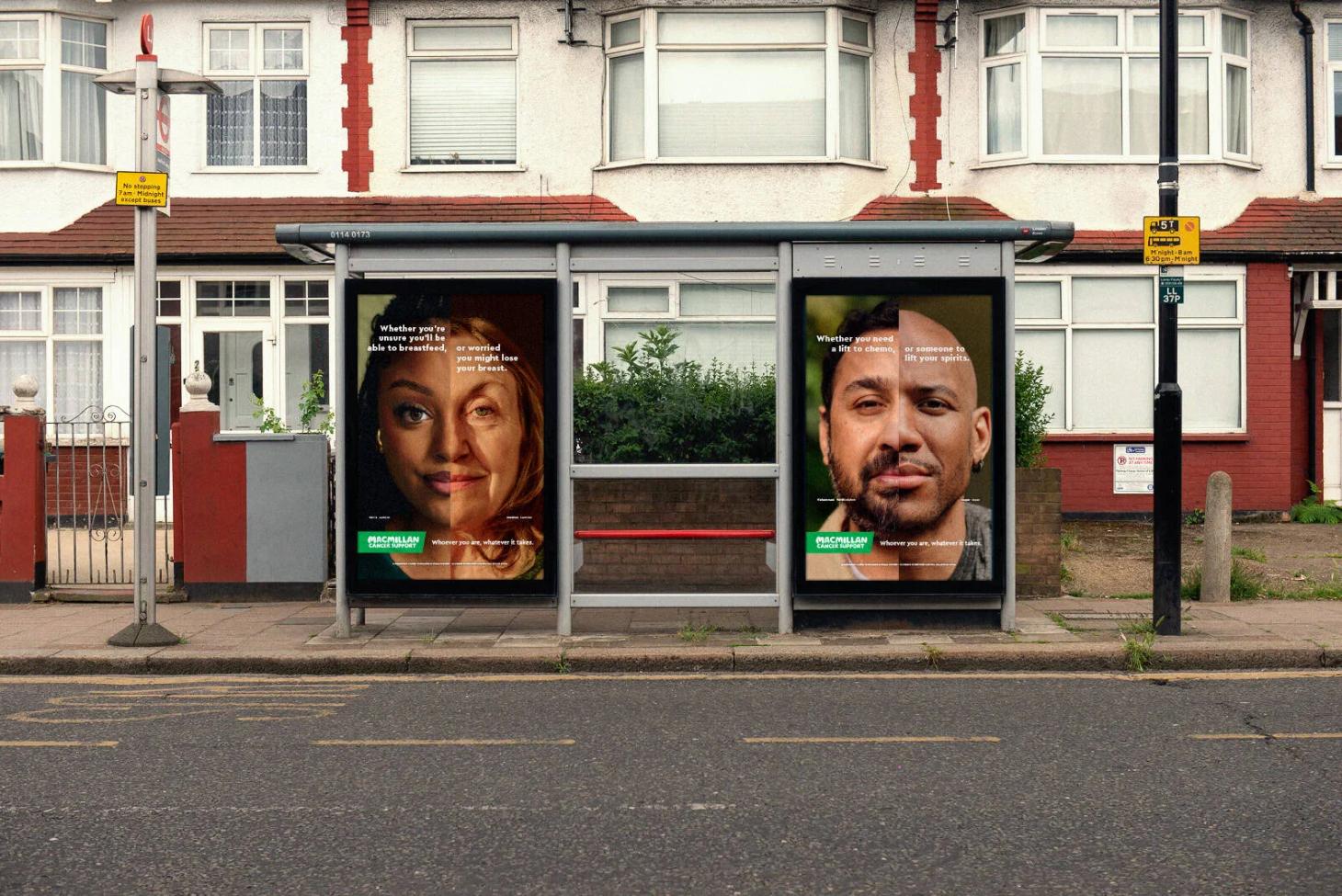
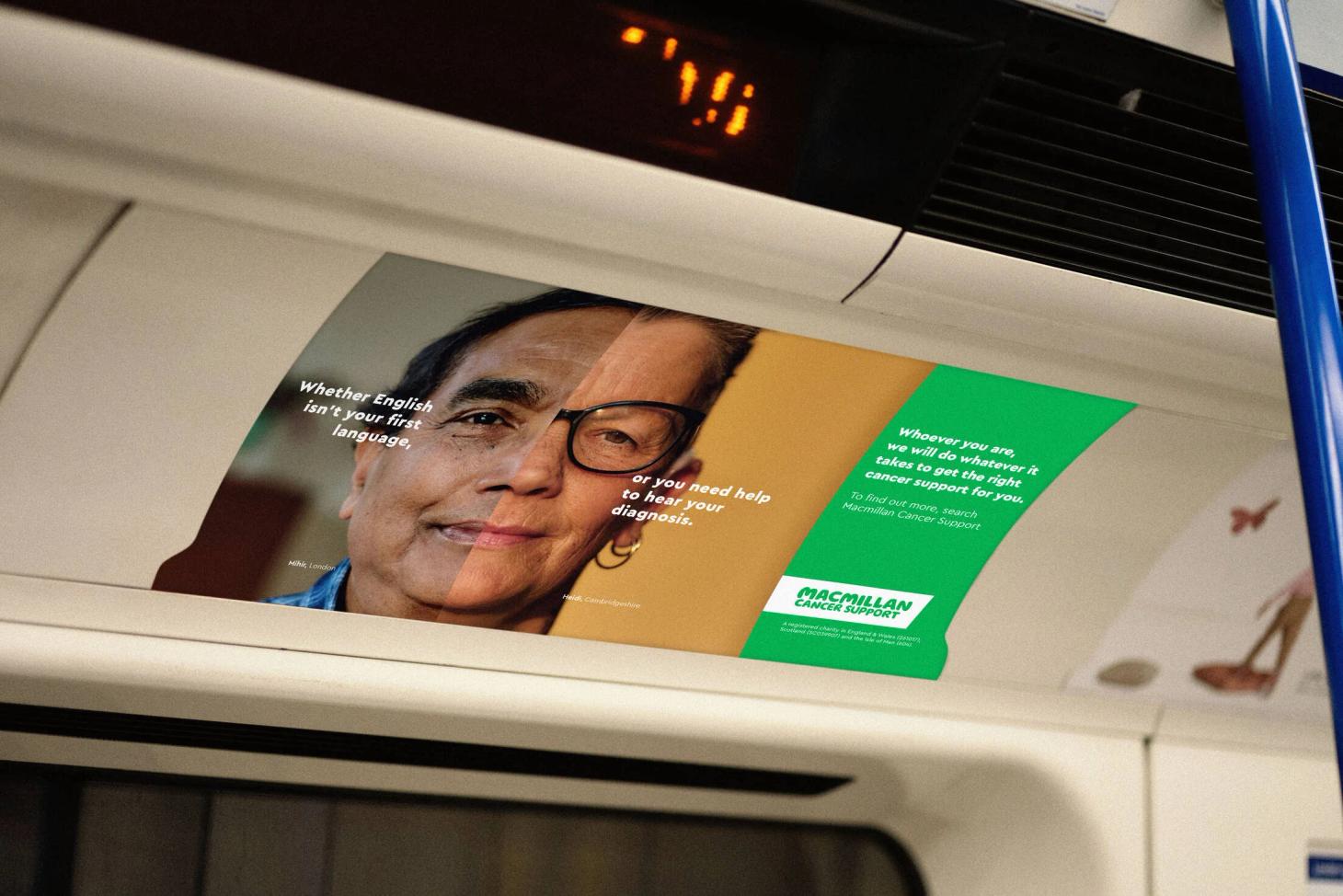
Macmillan Cancer Support's Faces of Cancer ran out-of-home portraits built using a split-face technique: each image merges two people from different backgrounds who are each living with their own experience of cancer. Almost 3.5 million people in the UK are living with cancer, and the work reflects how consistent Macmillan's support is, despite how different each person's experience is.
What made it work
The split-face composite does all the talking. It does not state Macmillan's breadth of support; it makes you see it in a single image, which is harder to scroll past than a headline. Most poster work is seen and forgotten. The composite interrupts that pattern by making the viewer do a double-take, which is the moment a poster becomes a photograph someone takes and posts.
The results
Faces of Cancer ran nationally across out-of-home in May 2025. For a static medium with no shares button, earned reach depends entirely on whether the creative is worth photographing. This one was.
The lesson
Press and social pickup follow the image that does not resolve on first glance, not the one that states its message and stops.
Shelter “Brave Face” by Don't Panic London (Christmas 2022)
Shelter's Brave Face landed at Christmas 2022 and earned 290 pieces of press coverage with a reach of over 688 million, taking a British Arrows award along the way. The campaign sat within a multi-year partnership between Don't Panic London and Shelter, and it worked the seam between festive cheer and housing reality.
What made it work
Christmas is the most contested ad window of the year. Cutting through it as a charity means refusing to compete on warmth, and instead naming the gap between the season's story and the lived one. With 176,130 children now in temporary accommodation, the Christmas frame gives the statistic a stage, and gives editors a reason to run the story when every brand is fighting for the same column inches.
The results
Brave Face generated 290 pieces of press coverage, reached over 688 million people, and took a British Arrows award. Not bad for a campaign that refused to compete on Christmas cheer.
The lesson
Give the press a sharp seasonal contrast and they will do the heavy lifting at the most contested time of year.
Women's Aid “The Monster Who Came to Tea” by House 337 (2025)
According to a January 2025 Women's Aid press release, 1.6 million women and 1.8 million children experienced domestic abuse in 2023/24. Almost as if in response, Women's Aid and House 337 reimagined the children's classic The Tiger Who Came to Tea as The Monster Who Came to Tea in March 2025, narrated by Anne-Marie Duff.
The film ran in Pearl & Dean cinemas, backed by out-of-home, an open letter to the Prime Minister, and school lesson plans.
What made it work
Taking a beloved bedtime story and turning its gentle visitor into something menacing gives press an instant, recognisable angle, and gives audiences a frame they already hold. The distribution was built in layers, not channels: cinema gave it a captive screen, the open letter gave it a news peg, and the lesson plans gave it a life in classrooms long after the media moment passed.
The results
It’s hard to make people sit with domestic abuse. The campaign ran in cinemas nationwide (giving it a captive audience), landed national press coverage, and reached classrooms through lesson plans distributed to schools across the UK.
The lesson
Borrow a story the audience already loves and you buy the attention needed to hold them through the difficult part.
Medical Aid for Palestinians, I Know (2025)
Medical Aid for Palestinians asked Don't Panic London to cut through audience fatigue around Gaza and bring renewed attention to the collapse of its healthcare system. The answer was I Know: a single-shot, 60-second film told through the eyes of a Palestinian doctor, shot with raw authenticity and guided by real doctors and cultural advisors.
What made it work
The brief was to highlight the scale of the crisis without sensationalism, and the single-shot format enforces exactly that discipline. There is nowhere to hide in one unbroken take: no edit to reach for, no cutaway to soften the moment. The camera stays with the doctor, and so does the viewer. That formal constraint is what gives the film its weight.
The results
I Know launched across MAP's channels in October 2025, supported by PR and press, including coverage in Campaign. For a campaign built on restraint rather than spectacle, press pickup at that level confirms the approach: the less the film performs, the harder it is to look away.
The lesson
On the gravest subjects, documenting plainly beats performing emotion. A single unbroken shot asks more of the viewer than a hundred cuts, and gets more back.
CALM “This Is Not a Drill” by T&Pm / Common People Films (2025)
CALM's This Is Not a Drill, made by T&Pm with Common People Films in January 2025, used drill music and comedy across TikTok and Instagram to get young men talking about mental health.
What made it work
Drill and short-form comedy are native to the exact audience CALM needed, so the work lives where the conversation already happens instead of dragging viewers somewhere unfamiliar. You do not earn this audience by buying placements around them. You earn it by speaking in a register they recognise as theirs, then letting them spread it.
The results
The campaign ran across TikTok and Instagram in January 2025, generating coverage in Creative Review, LBBOnline, It's Nice That, and Ads of the World on launch. For a mental health campaign targeting young men, trade press pickup at that breadth is its own signal.
The lesson
Meet the audience inside their own culture and they handle the distribution.
WaterAid “What Jack Gave” by Don't Panic London (2022)
WaterAid's What Jack Gave, made by Don't Panic London, took Best TV Film at the Silver Marketing Awards. The campaign turned the act of giving water into a story with a character at its centre, rather than a plea built on need alone.
What made it work
Most water-charity work leads with scarcity and suffering. Leading with generosity instead gives audiences something warmer to carry and, crucially, to repeat. A film people associate with a feeling of giving rather than guilt is one they are more willing to share.
The results
What Jack Gave took Best TV Film at the Silver Marketing Awards. The award confirms the craft; the reach came from a reframe that made giving the story, not the ask.
The lesson
Make giving the story instead of the ask, and the audience carries it further than guilt ever would.
What the best charity campaigns have in common
Seven campaigns, one pattern underneath. We call it the Earned-Media Stack: the layers that, stacked together, make charity work travel without a media budget to push it.
The Don’t Panic Official Earned Media Stack™:
- Human stake at a specific scale. Not "homelessness" but 176,130 children. Not "abuse" but 1.6 million women in a year. A precise number gives the emotion somewhere to land and gives the press a fact to anchor a story.
- Cultural timing or cultural borrowing. Most Shocking Second a Day rode a live format. The Monster Who Came to Tea borrowed a story the country already knew. This Is Not a Drill spoke in the audience's own genre. Each one plugged into something people were already paying attention to.
- Distribution the brand does not have to own. Cinema screens, school lesson plans, trade-press director announcements, a familiar internet format, an out-of-home image worth photographing. These are channels earned through interest, not bought through spend.
- A reframe that makes the issue harder to ignore than to share. A British child in a war story. Giving as the hook instead of need. A gentle bedtime tiger turned menacing. The reframe is what converts a worthy cause into a thing people choose to pass on.
Strip out the budgets and the awards, and this is the through-line: the campaigns that earned their reach earned it by making the work easier to spread than to scroll past.
Frequently asked questions
How much does a charity marketing campaign cost?
Charity marketing campaign costs range widely, from a few thousand pounds for a single organic film to six figures for an integrated campaign with cinema, out-of-home, and production at scale. The campaigns that earn the most reach are not always the most expensive though; many travel on press pickup and organic sharing rather than paid amplification.
How do you measure the success of a charity marketing campaign?
Success in charity marketing should be measured by earned reach, not just spend efficiency. Useful metrics include press coverage volume, organic shares and completion rates, subscriber or supporter growth, and donation uplift. The strongest signal is whether the work generated attention the charity did not pay for, which is the clearest sign it cut through.
Do charity campaigns need a big budget to work?
Charity campaigns do not need a big budget to work, and several of the most-shared examples prove it. What they need is a specific human stake, cultural timing, and a reframe that makes the issue worth passing on. A sharp idea with a small budget routinely out-travels a generic one with a large one.
What is the difference between a charity marketing campaign and a PR stunt?
A charity marketing campaign builds a sustained creative idea across channels, while a PR stunt engineers a single attention-grabbing moment. Stunts chase immediate coverage; campaigns build a narrative that compounds over time. Both have their place, as our breakdown of the best charity PR stunts explores in more detail.
How is charity marketing different from commercial brand marketing?
Charity marketing carries higher emotional stakes and tighter budgets than most commercial brand marketing, which forces it to earn attention rather than buy it. Commercial work can lean on media spend to guarantee reach. Charity work has to make the audience want to spread the message, which is why the best of it is built to be shared.
The best charity campaigns don't buy attention. They make it unavoidable
Paid media rents reach. The campaigns above earned it, and the difference shows up in press coverage, completion rates, and films that spread for years after the budget ran out.
What that points to is a shift in how the strongest charity work gets made. The brief is no longer just creative; it is a distribution question. What will give people a reason to pass this on? What makes the issue harder to ignore than to scroll past? The charities answering those questions well are the ones building audiences that compound, not just campaigns that land.
If that is the kind of work you want to make, Don't Panic is perfect for you. Take a look at our earned media work or get in touch.